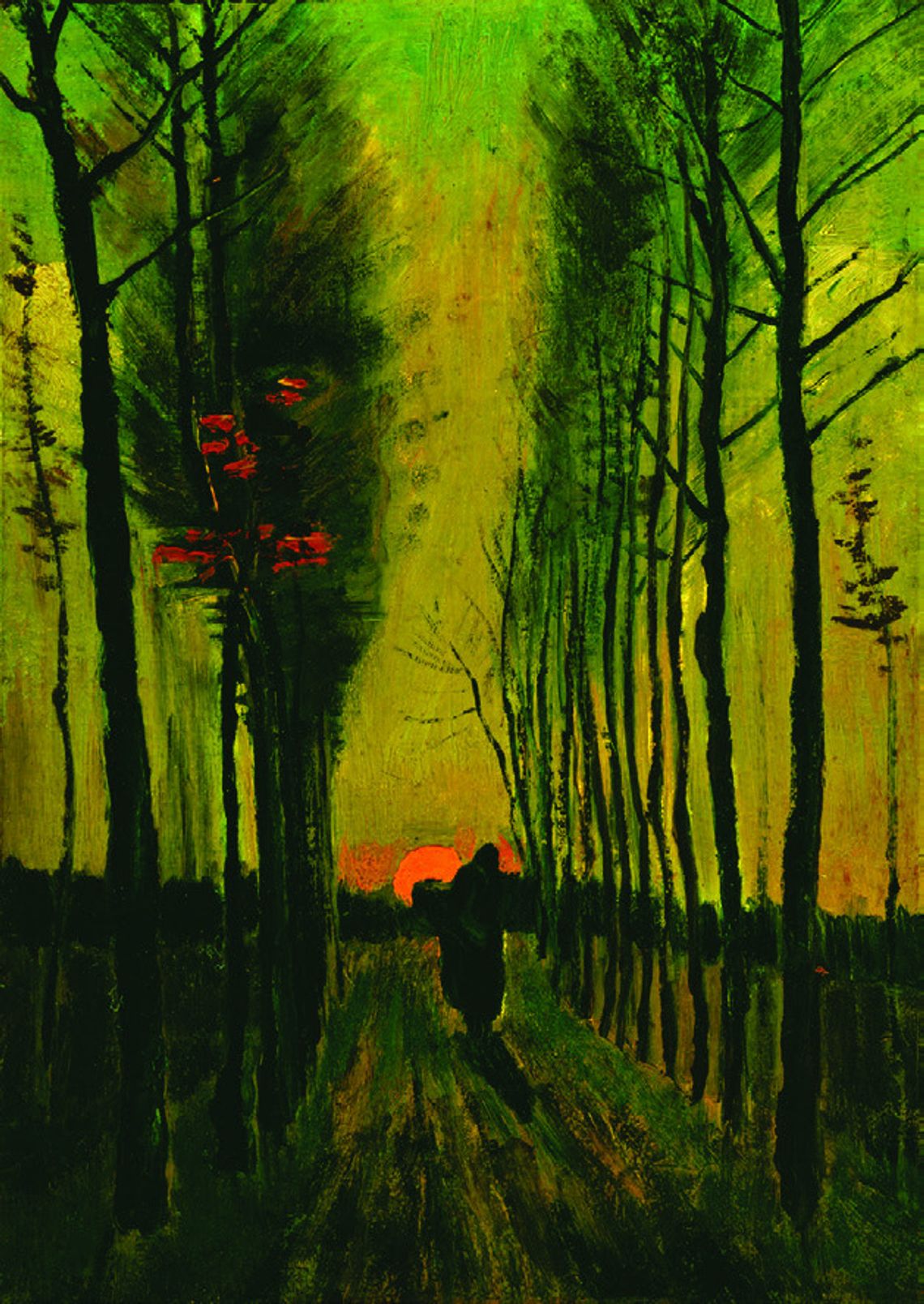
In his iconic painting, Lane of Poplars at Sunset, famed Dutch master Vincent van Gogh depicted the glowing orange disc of the setting sun low on the horizon, centered on a long, straight lane flanked on each side by a row of skeletal poplar trees nearly bare of leaves.
It is a scene strikingly similar to New York’s “Manhattanhenge,” where the setting sun aligns with Manhattan’s numbered streets on dates near May 29 and July 12 annually. Hayden Planetarium Director Neil deGrasse Tyson drew attention to the phenomenon in 2001 and it has remained a popular event ever since.
Those similarities caught the attention of Texas State University astronomer, physics professor emeritus and Texas State University System Regents’ Professor Donald Olson, who suspected astronomy could determine when and where van Gogh painted this striking scene more than 130 years prior. Utilizing his distinctive brand of celestial sleuthing, Olson had previously dated three of van Gogh’s famous paintings: Moonrise (Wheat Stacks), Road with Cypress and Star and White House at Night using similar methods.
Olson’s instincts proved correct. With assistance from Louis Verbraak and Ferry Zijp, members of the Eindhoven Weather and Astronomy Club in the Netherlands, Olson determined that van Gogh painted Lane of Poplars at Sunset shortly before sunset on Nov. 13 or 14, 1884 along a straight stretch of road known as Weverstraat in the Dutch town of Nuenen.
The team’s findings are published in the November 2024 issue of Sky & Telescope magazine, on newsstands now. Olson’s first order of business was determining where the lane existed.
“If we could identify the lane on 19th-century maps, then we’d be able to establish the compass direction of the road appearing in the artworks,” Olson explained. “Next, we could use astronomical calculations to determine the date when the disk of the setting sun aligned as van Gogh portrayed it.”
For historical research, van Gogh’s paintings are referenced by their catalog numbers as assigned by Dutch art historian Jacob Baart de la Faille in his 1928 compilation of the artist’s complete works. Lane of Poplars at Sunset is assigned F123. As Olson investigated further, he discovered catalog painting F122, known today as Lane of Poplars in the Autumn, must depict a scene earlier that autumn. The trees in Lane of Poplars in the Autumn have abundant leaves with vivid fall colors, while the leaves are almost completely gone from the trees in the sunset depiction.
Art historians have long depended on van Gogh’s many letters to his brother Theo to date most of the artist’s work, and Olson turned to these to see if either F123 or F122 were mentioned. A total of three letters, written by Vincent during late October and early November of 1884, describe the lovely autumn weather he was experiencing. Letter 467, dated on or about Oct. 25, 1884, includes a description that matches Lane of Poplars in the Autumn: 'The last thing that I made is a rather large study of a lane of poplars with the yellow autumn leaves, where the Sun makes glittering patches here and there on the fallen leaves on the ground, alternating with the long shadows cast by the trunks.
At the end of the road is a peasant cottage, and above it the blue sky between the autumn leaves.'
Letter 466, dated Oct. 22, 1884, indicated that the trees would completely shed their leaves by approximately Nov. 5, and in letter 469, dated on or about Nov. 14, 1884, van Gogh indicates that freezing weather has arrived, forcing him to abandon painting outdoors for the rest of the season. These letters establish a time frame between Nov. 5-Nov. 14 for van Gogh to have painted Lane of Poplars at Sunset. Within this range of dates, planetarium software shows that the sun set in the southwest, in the range of azimuths, or compass direction of a celestial object, between 240° and 244°.
Although the location of Lane of Poplars in the Autumn contained similar subject matter, the well-documented location in the nearby village of Nederwetten did not match the scene depicted in Lane of Poplars at Sunset, so Olson had to look elsewhere. In the Brabant Historical Information Center in ’s-Hertogenbosch, Olson consulted detailed maps from 1883 showing the roads in Nuenen and nearby villages. Looking for straight roads oriented toward the southwest, Olson identified three candidates: Hoekstraat in the town of Nederwetten, Braakweg on the west side of Nuenen and Weverstraat running from the center of Nuenen.
Hoekstraat, although close to the location of Lane of Poplars in the Autumn, appeared to be too short of a road to accommodate the large number of trees depicted in Lane of Poplars at Sunset. Braakweg proved to be even shorter. Weverstraat, however, boasted a long straightaway of 1,200 feet, or 365 meters, more than long enough for the scene painted by van Gogh.
Astronomical calculations showed the setting sun would’ve been visible setting over Weverstraat on Nov. 13 or 14, 1884. Historical weather records indicate these dates fall within a five-day span where the area experienced unseasonably clear weather.
Because van Gogh rarely painted from memory and preferred to have his subject in front of him, Nov. 13 or 14, 1884, are the only possible dates for the creation of Lane of Poplars at Sunset.
“Today, we can still gaze down the same stretch of road where van Gogh walked on a chilly autumn afternoon and ponder how the artist, in his native Netherlands, was already interested in portraying sky phenomena, four years before he began to create his famous starry nights in the south of France,” Olson said.