LOCAL ARTIST
A look at the career of Christopher Paul Cardoza
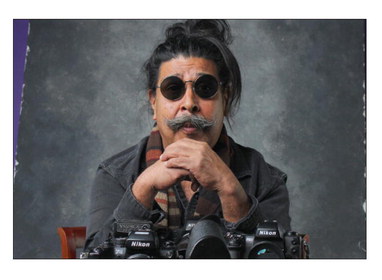
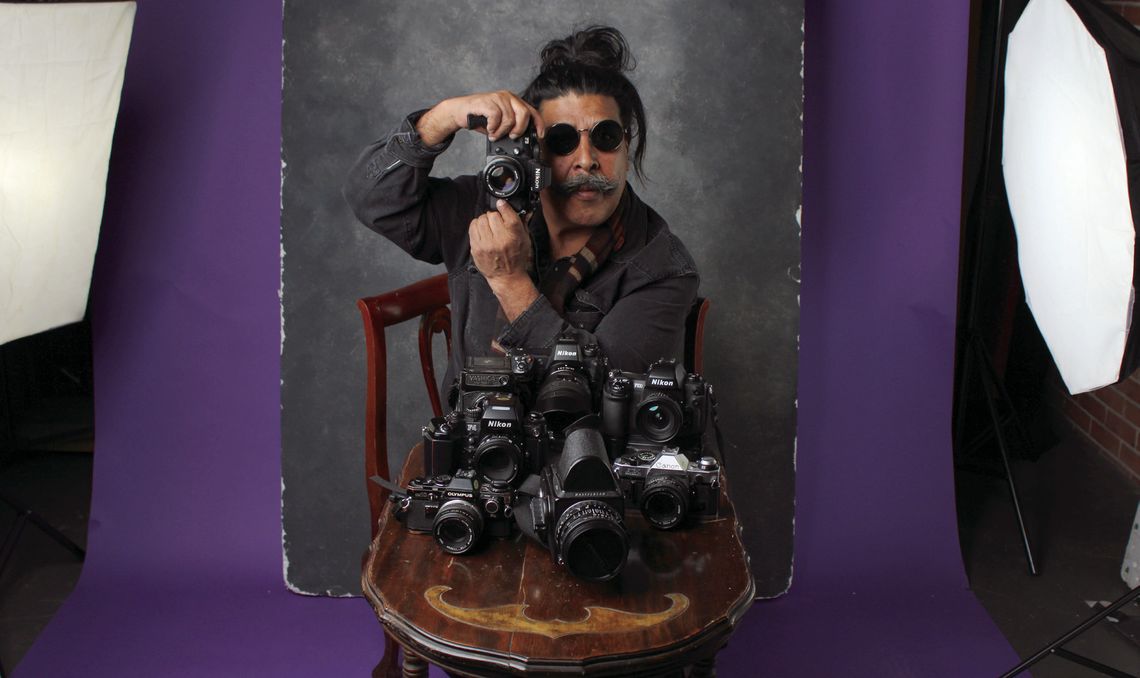
If any local were to think about San Marcos photography, the first person to come to mind would surely be photographer Christopher Paul Cardoza, who has made it his mission to capture everyone in town and has likely gotten damn close. Though Cardoza spent his formative years in California, he has made San Marcos his home over the past 14 years, so much so that his mother’s last words to him before she passed away were, “Go home with your family. Go back to Tejas. Go to your family and love them.”
Cardoza’s passion was spurred by a moment of kismet that occurred at the intersection of his two favorite things: music and photos. As a kid, Cardoza would spend time in his musician brother’s room because “he had all the good records.” His brother had an iconic poster of Jimmy Page and Robert Plant, two members of Led Zeppelin, and he said he found himself intrigued and a little intimidated by the striking image of “these two guys with real long hair, almost demonic-looking, Nordic, powerful.” In an attempt to get to know the two people whose picture had brought him a sense of awe and curiosity, he sat back and dropped the needle onto a Led Zeppelin album, while, also for the first time, cracking open a copy of Dispatches by Michael Herr. The book told the story of Herr’s time as a journalist covering the Vietnam War for Esquire Magazine along with three war photographers: Tim Page, Sean Flynn and Dana Stone.
“The book impacted me so much; I wanted to be those guys. I looked up their work. I found out who took that f***ing picture of Led Zeppelin, and I just kind of went from there,” he said.
He asked for his first camera for Christmas when he was around 12 years old. He had opened all of his presents, so he thought, and was disappointed to not have received the gift he was hoping for.
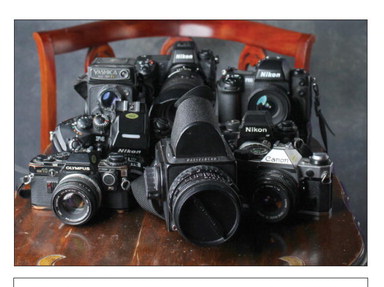
“Then Mom’s going, ‘Wait, [there’s] just one more … back there,’” Cardoza said. “It was my first camera — an Olympus OM-10.”
He took his camera everywhere, shooting everything and everyone that he came across. He described himself as a poor kid “from the other side of the freeway,” who, with his camera, was able to traverse social lines.
“I was able to infiltrate the jocks, the cheerleaders, the baseball team, the rockers, the punks, the bad guitar players, and all the doughey-eyed teenage dragon slayers. I got invited to all this stuff,” Cardoza said, adding that he noticed when he put his camera down that he must have had a good personality “because a lot of them stuck around.”
Cardoza took journalism classes at a local college, and got a job in the darkroom at the Rialto Record by asking the photographer if he needed any extra hands. And “as fate would have it,” he managed to get on the field of an L.A. Raider’s game when a photographer with a broken camera came running up to him asking if he captured any photos that he could purchase.
“Turned out he worked for the L.A. Times,” he said. “My pictures got in the paper.”
During college is when “the film bug hit” because of the crew Cardoza was hanging around, including John Singleton, who went on to direct “Boyz n the Hood.” Cardoza then began working in the film industry for the next 15 years.
“I literally went back to pack up and just go back home and commute to L.A., which is like 45 minutes away. And I worked everything. I hooked up with a production company called The End Production and Gun for Hire Films as a PA — production assistant,” Cardoza said, adding that it’s difficult to list all of the projects he worked on during his film career because of the sheer number of them. “At that time, The End had the reputation of producing almost 80% of the rock videos you saw on MTV.”
He moved his way up to a grip, which focuses on setup and maintenance of equipment. He also served as a stand-in for several cameramen on larger productions.
“My camera lay dormant for literally 20 years,” he said.
Cardoza said his life “went to hell in a handbasket” due to his alcohol and drug use during his time in Hollywood, but sobriety gave him “clarity.”
“Because in drinking and using, I spent a good amount of my life dreaming, wishing, hoping, wanting and looking at life from the outside in,” Cardoza said. “When I got sober, it changed my direction and how I viewed life. … It was not about putting down the drink. It was not about putting down a needle or a straw. It was about changing the way I lived, and more importantly, how I felt about myself and about you.”
When Cardoza got sober, he was feeling “a lot of inspiration” but wasn’t sure what his next steps should be. He picked up a digital camera, and “something started happening,” but it was another event that would cement the choice. Shortly after, Cardoza was talking about his favorite movie Apocalypse Now with a friend, when his pal recommended a book by Michael Herr, noting he was the guy who wrote the narrations for the movie.
“And I go, ‘Is it Dispatches?,’” Cardoza said. “And he gave me a copy of Dispatches.”
The same book that sparked his passion all those years ago, had done it again. Cardoza and his camera were officially reunited.
He got offered a contract job doing photography in San Marcos.
“My first paycheck, I went out and bought a really nice camera, and I just started walking around town. I started going into all these places where I heard music, [where] I heard people laugh. I’d take a picture here, a picture there. And one day, I went to a place called Triple Crown,” he said.
Cardoza asked the band if he could shoot them and became “kind of the resident photographer over there.” Then he was “everywhere that every band was playing,” cementing himself as a local staple and expanding his photography portfolio, which has grown immensely since that time.
“I’ve worked with a lot of interesting people [such as] Willie Nelson. I did a lot of South Bys. I’ve done a lot of Utopia Fests, met big name bands that came through that,” Cardoza said. “I paid no attention to who I was photographing. Willie Nelson was the only person that was kind of unnerving to me.”
He even got to photograph one of the rock stars from the poster that he admired so much as a child, Robert Plant.
And as for the images he creates, Cardoza calls himself a Photo Documentarian, not governed by any one style or type of photography.
“I tend to break out and do a little bit of everything,” he said. “The nicest thing for me to hear — and it happens quite a bit, which means I’ve been doing a lot of work — is someone coming up to me and saying, ‘Hey, you may not remember me or know me, but my dad or my mom, and in one case, my daughter, are no longer with us. But you took a picture of them, and I remember they liked it. We really liked it. We still have that photo.’ And I get a lot of that.”
He sees his photography journey as replacing one addiction for another in a lot of ways.
“I photograph the way I [used to] drink,” Cardoza said. “No matter what I go through, no matter what I feel — disappointment, heartbreak, sadness, loss, fear, insecurity, financial insecurity — I haven’t found it necessary to take a drink. Instead, I get up, and I just walk around with a camera.”
In addition to photographing out in the community, Cardoza also shoots out of the studio he co-owns with Kileigh Reed in Martindale, Cotton Seed Studios TX. Follow him on instagram @ cpaulcphotography.