As Spring arrives, consider adding native plants to new gardens
As spring arrives in Central Texas, gardeners are ready to plant some lovely new flowers whether they are new editions to the garden or replacements for plants that did not survive the winter. Considering the challenges of our heavy clay or rocky soils and the need to conserve our precious water, natives are the way to go.
A native plant is one that has evolved in a region and grown naturally without human intervention. There are several advantages that these plants have over non-natives. They are accustomed to the soil texture and composition in our area, to the heat and drought we experience, and provide food and shelter for wildlife indigenous to our area. As a result of these characteristics, they require less water, fewer if any soil amendments, and no chemical pest or disease treatment. There are many perennials native to the Edwards Plateau and/or the Blackland Prairie (our part of Texas) which are beautiful and come with all these advantages, but here are a few of my favorites.
Mealy Blue Sage, Gregg’s Blue Mistflower, and Cedar Sage are herbaceous perennials which die back in the winter but come back from their roots in the spring. Mealy Blue and Gregg’s Mist grow in full sun, need very little water, and bloom from spring to frost. Their lovely purple blossoms are magnets for butterflies, bees, and hummingbirds. The Cedar Sage grows well in shade. It is one of the first to bloom, showing its lovely red flowers in early March. All these plants bloom more heavily if the spent blossoms are removed periodically.
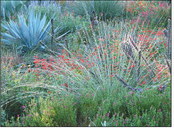
Photos from Texas A&M Agrilife Extension
The Salvia Greggii (autumn sage) and Rock Rose are two native woody perennials which shine in our gardens. The autumn sage comes in a myriad of colors, but red and white were the original colors. It is evergreen, providing some green in the garden where most perennials are brown in the winter. The Rock Rose has lovely small pink blossoms April to first frost. It will lose its leaves in the winter but will have new leaves and blossoms on the old wood come spring.
For more diversity in the garden, native grasses and succulents are an option. Gulf Muhly Grass is one of the most colorful of our native grasses. It is green most of the year and displays wispy purple/pink fronds which sway in the breeze in the fall. These make quite a statement if planted in groups of three or more. A native succulent which requires basically no care and is evergreen is the Texas Sotol. It has slim fronds which are spiky on the edges, making it a perfect plant for the center of a garden surrounded by the hardy herbaceous and woody perennials discussed earlier.
For information on these and other native plants, find the Grow Green brochure (www.growgreen. org) or the Texas Superstar brochure (Texas Superstar Brochure 2023) online.
Happy Gardening!