Dr. Grady Early, Distinguished Professor Emeritus, taught math and computer science at Texas State University for 29 years, serving briefly as interim chair of the newly-formed Computer Science department. After retirement, Early began researching his family history and gained some familiarity with various research tools: ancestry, familysearch, newspapers, San Marcos Record archives, findagrave and many more. This made it easy for him to segue into the histories of non-family members, which is how he began to write a story about Southwest Texas Normal in San Marcos, also known as San Marcos Normal, which is now Texas State University. This series will highlight the first staff at Southwest Texas Normal.
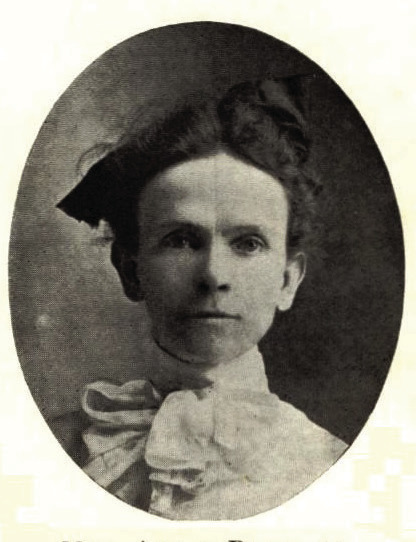
“[Annie Goodloe] Pearsall was Manager of the Art Gallery; can draw pictures; patron of Raphael, Titian and Michelangelo, according to the 1907 Pedagogue.
Pearsall appeared as Anna in the 1860 and 1870 censuses. Her father John Edward Pearsall was born in North Carolina and moved to Tennessee where he met and married Elizabeth James Williams. Pearsall’s sister Grace and brother Richard were born in Tennessee, then the family was GTT — Gone to Texas — where Pearsall was born in 1857 in Fayette County, Texas.
Pearsall’s early academic life is obscure. In 1870, as a 13-year-old, she was in Fayette County with her parents and four siblings. By 1875, she was in Galveston County where she achieved some distinction by translating Goethe’s “Erlkönig,” which was published in the Galveston Daily News. In 1875, Pearsall was 18 years-old and had probably just graduated from Mrs. Goodwin’s school with a “First Honor,” possibly for the translation.
Where Pearsall attained her teaching certificate is unknown, but by 1884, she was at Oenaville, Bell County, and had begun attending state teachers’ association meetings. An 1886 meeting at Belton saw the presentation of several papers. One was “Supplementary Reading and Arithmetic Charts” by Miss Annie Pearsall, Barclay, which is in Falls County, about 16 miles east of Temple.
Her father died in 1887 and is buried in Bell County.
In 1898, Pearsall attended the summer normal in Austin. Then in 1899, she joined the faculty of the State Institution for the Blind. She was “from Santa Anna” in Coleman County.
Pearsall stayed at the Institution for the Blind until Tom Harris persuaded her to join the department of history, civics, and geography at SWTN. That first year, 1903 to 1904, was considered an unqualified success. Some faculty left for summer vacation. Pearsall left for a month in St. Louis, Missouri.
Other faculty stayed to labor away at SWTN’s first summer normal. The San Marcos society editor reported to the Austin Statesman: “The summer normal at this place closed on Thursday with examinations. The faculty furnished refreshments during the noon recess, which was much appreciated by the tired teachers and pupils. The term has been quite successful and the Southwestern [sic] Normal promises much for next session. That next session ran 1 June to 27. July, 1905; Pearsall pitched in, then vacationed in Arkansas.”
Pearsall’s employment was secure. Or was it? When the Board of Regents met on Dec. 11, 1911, it set salaries for all of the normals. Annie Pearsall, Geography and Drawing, was allowed $1,200 for the year:
• 1912 Geography and Drawing $1,350.
• 1913, 1914, 1915 Drawing $1,350.
• And then, 1916. Annie Pearsall, no title, but dead last, below the janitors, $50/month! The board instructed President Evans to notify Miss Annie Pearsall that he could no longer use her as Drawing Teacher, but that other employment would be provided for her at a salary of $50 per month.
It’s unlikely that the board would have issued that instruction if Evans hadn’t asked to be so instructed. Nevertheless, it appears to be so; Pearsall’s appearance in the 1916 Pedagogue was her last. If that “other employment” materialized, it is not in the record.
Pearsall’s association with teaching did not end with her dismissal from SWTN. In 1920, she was the Hays County representative to the Examining Board for summer normals, and, on the census, she was listed as a state normal teacher, location unspecified.
Nor did Pearsall quit San Marcos where she stayed active in social circles, particularly with the local chapter of the Daughters of the American Revolution where Pearsall held several offices: Historian, Vice-Regent and Chaplain. She also visited, and was visited by, various family members.
Then, fire struck. On Tuesday, Dec. 13, 1927, the Vista street home of Miss Annie Pearsall was destroyed by a fire that broke out about noon. All the household effects of Miss Pearsall and of Professor L.N. Wright and family, the other residents of the house, were ruined. The estimated value of the loss of house and furniture amounts to $6500, while insurance amounting to $3500 was carried. The house was rebuilt, but by 1930, Pearsall had relocated to Buena Vista Street. Vista Street is on West Campus; Buena Vista is on the other side of Old main. A lifetime of teaching records were gone.
On Jan. 2, 1929, Pearsall was summoned to San Antonio. Her nephew Sam Scott and a fellow student at Baylor Medical college in Dallas had burned to death in a rooming house fire. The body was returned to Scott’s family in San Antonio for burial in the family plot in Clareville, Bee County, where Scott’s mother “Attie” had been buried in 1917.
Pearsall stayed active with family, friends and clubs until her death in Austin in 1937. She inspired students with her love of art.
More information about her grave can be found at Findagrave # 115835005.