GROWTH AND DEVELOPMENT
Multiple regional economic development organizations, including the Hays Caldwell Economic Development Partnership, recently convened at Texas State University to discuss business attraction, infrastructure expansion, retention and workforce development. According to a press release issued before the event, in 2024, Texas had 0.6 percentage points of growth more than the US job growth rate, and the cities between San Antonio and Austin have consistently ranked among the fastest growing in the country.
“The San Antonio-Austin Megaregion is driving progress and innovation as the region of the future. The megaregion is uniquely positioned to foster one of the most dynamic economic zones in the U.S. economy,” the press release stated. “To build on this momentum, regional economic development organizations and their investors are convening to discuss regional wins and opportunities to continue driving the region forward. As the megaregion continues to emerge, this partnership is both essential and forward-thinking.”
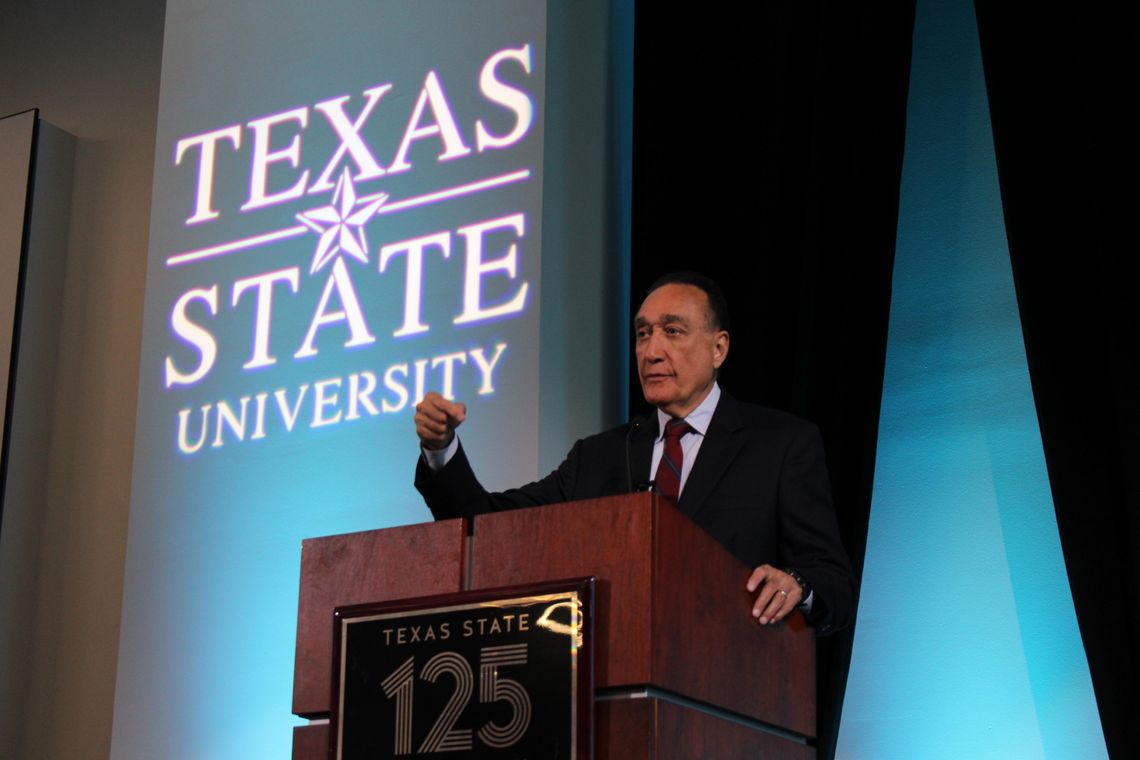
Henry Cisneros, former HUD secretary and former San Antonio mayor, was the keynote speaker for the event. He said he has written a book with Robert Rivard and David Hendricks called “The Austin–San Antonio Megaregion: Opportunity and Challenge in the Lone Star State.” He added that his speech would address some of the things they learned throughout the bookwriting process.
“If you look at the region as a whole, it is … San Antonio Metro at 2.7 million and the Austin Metro at 2.5 million,” Cisneros said. “If we combined the region and thought of it as a metro, it would be the 10th largest metro in the nation.”
Cisneros made some predictions using the growth rate of the past 25 years to predict what the population would be in 2050.
“The population then of this region will be 8.3 million people, which is larger than the DFW Metro, now at 8.8 million people, and in 2060, just 10 years later, it would be 9.6 million people,” he said. “So this area is going to grow. It’s not a question of if. It’s only a question of at what pace and whether or not we’re prepared for it.”
Cisneros began to read from a fictional article from the future — dated Aug. 1, 2035 — as a cautionary tale for what could occur if preparation for that growth does not occur.
“Because transportation leaders fail to add adequate capacity for existing roadways and have not completed significant mass transit projects across the region, traffic has become so severe that it seriously hinders mobility,” Cisneros read from the fictional, future article. “Congestion actually reinforces the separation of communities ... It causes business productivity losses directly attributable to travel times that have become unpredictable and excessive.”
Cisneros pointed to the Los Angeles and San Diego area as places where it is impossible to plan a timely trip from one city to the other “because they’ve just been inattentive to adequately dealing with the congestion problems in that region.”
He continued reading from his fictional article, citing a phenomenon that is already occurring in Phoenix as something that could happen here without proper planning.
“Strict mandatory water conservation requirements have become necessary as recurrent droughts and water overuse have reduced reliance on the Highland Lakes and overdrafting of groundwater has damaged water quality in the area’s aquifers, resulting in intermittent suspensions of residential building permits across the region,” Cisneros read from the fictional article.
He then used his future article metaphor to discuss the impact of education development and planning.
“Uneven educational outcomes across the region’s K through 12 schools have made it impossible to create a pool of tech ready graduates of sufficient size to match the demand for workers,” he read. “Additionally, low school performance scores impede the path to higher education and are forcing new economy companies to look elsewhere to fill their workforce needs; that leaves local students at lower wage jobs and pushes both poverty levels and social tensions higher.”
He pointed to the need for business, education and political leaders to join together for solutions to the growth problems being faced by the region in order “to make our public sector agencies and officials recognize the things that have to be done.”
He said there are seven factors that need economic development specialists attention:
• Traffic congestion
• Water
• Housing affordability
• Manpower and training for the workforce
• Airports and air routes
• Additional Major League Sports Teams, including NFL
• Cooperative structures
For more details, check out Cisneros’ book “The Austin–San Antonio Megaregion: Opportunity and Challenge in the Lone Star State;” It is available for preorder on Amazon and tamupress. com.