ROTARY CLUB OF SAN MARCOS
Dr. Grady Early, Texas State University professor emeritus, likes to conduct research for fun. He started by researching his family history, and his curiosity grew then shifted to the city’s beloved university — the one he spent so many years teaching at. After looking into the first 17 faculty members at then San Marcos Normal, now TXST, he wrote a series about them for the Daily Record, which caught the attention of the Rotary Club in San Marcos who invited him to speak at one of their meetings. Instead of the first faculty, Early decided to look at the school’s history on a grand scale, from the first people teaching in the area to the legislation that paved the way for what is now Texas State.
“I got thinking about educating kids in particular, wondering how long we’ve been doing that in Texas, and I decided that the answer is 20,000 years. Because paleontologists seem to think that the first human being showed up in what is down Texas about that long ago. If you have people, you have kids and kids have to be taught things so that they will live long and prosper. Do not play with the brown snake,” Early said, which received a resounding laugh from the club members. “There will be someone in the village who is an expert at something [like] making bread; Maybe that person will gather some kids together and teach them how to do it. That is a school. All you need for a school are two things — a teacher and some teachees.”
He moved on to the 1870s and ‘80s when Texas had a large number of private schools but a shortage of teachers. The United States government conducted a census that asked if people could read or write.
“Texas had 800-andsome- odd-thousand people; of those 10 years and older who might be expected to know how to read and write, 200-andsome- odd- thousand could not. The legislature panicked, and a panicked legislature is not a pretty site. Something has to be done, so they decided to create a couple of schools to teach modern farming methods. What that has to do with the literacy problem — I do not know,” Early said. “They created two agricultural and mechanical colleges in Texas. One at Bryan which started teaching classes in 1876, and one at Prairie View, for blacks, which started teaching classes in 1878; those are the first two publicly funded institutions of higher education in Texas.”
The legislature then decided to address the issue of qualified teachers and decided to create some normal schools — a teacher training school concept taken from the French.
“In 1879, the legislature created two of them,” Early said. “Prairie View A&M was given the additional task of being a normal school. The second normal was Sam Houston Normal at Huntsville. There must have been a little grumbling from the legislators from the western part of the state saying something like, ‘look, we’re creating these schools. It looks like a little money’s going east. What about us?’ So in 1880, we got our first directional school, North Texas Normal at Dayton, and then the legislature paused to see how those three normals would do.”
During that time, the legislature created the state-funded University of Texas, which was the third endowed institution of higher education in the state. And San Marcos was next on the list for the home of a new normal.
“In 1899, we got our second directional school, Southwest Texas Normal,” Early said. “In 1909, [we got] West Texas normal [and], in 1917, East Texas normal. And then there was a little bit of a pause because we had some trouble. They called it the Great War. We call it World War I, but it sucked a lot of people out of Texas to go to Europe and fight. Eventually, as some of those came home, things settled down, and, in 1921, the legislature created the last two normals, South Texas Normal in Kingsville and Stephen F. Austin Normal.”
Early then moved on to the point of inception with the major question being — how old is Texas State University?
“That question is impossible to answer, specifically, because birth is not an event; It is a process. There are a lot of events in our early history that can be used to snatch a symbolic birth year. There were two events in 1899. In May, when Governor Sayers signed the act authorizing our existence. And, in October, when [the] Mayor … signed the deed transferring title to 11 acres of land on Chautauqua Hill to the state of Texas, so we would have a place to be if, in fact, we ever came to be. Another important date was in 1901 when the legislature actually appropriated money to build a building,” Early said. “1902 is when we set the cornerstone for Main; it wasn’t Old Main then.”
Early said that TXST cited 1899 as its birth date for its 125th birthday last year.
“I like 1899 and decided to apply that reason to my own self,” he said. “Consider — on May 10, 1899, Governor Joseph Draper Sayers signed Senate Bill 260, which authorized the creation of Southwest Texas Normal sometime, eventually, by and by. Well, On March 2, 1931 Reverend Steve D. Leslie signed my parents marriage certificate, thus authorizing them to create me sometime, eventually, by and by, and here I stand. So this past March, 2 was my 94th birthday. The only trouble I anticipate is convincing Social Security to go along with that for calculating my old-age benefits.”
Read more about the history of Texas State University at this link: sanmarcosrecord.com/ search?word=southwest+ texas+normal.
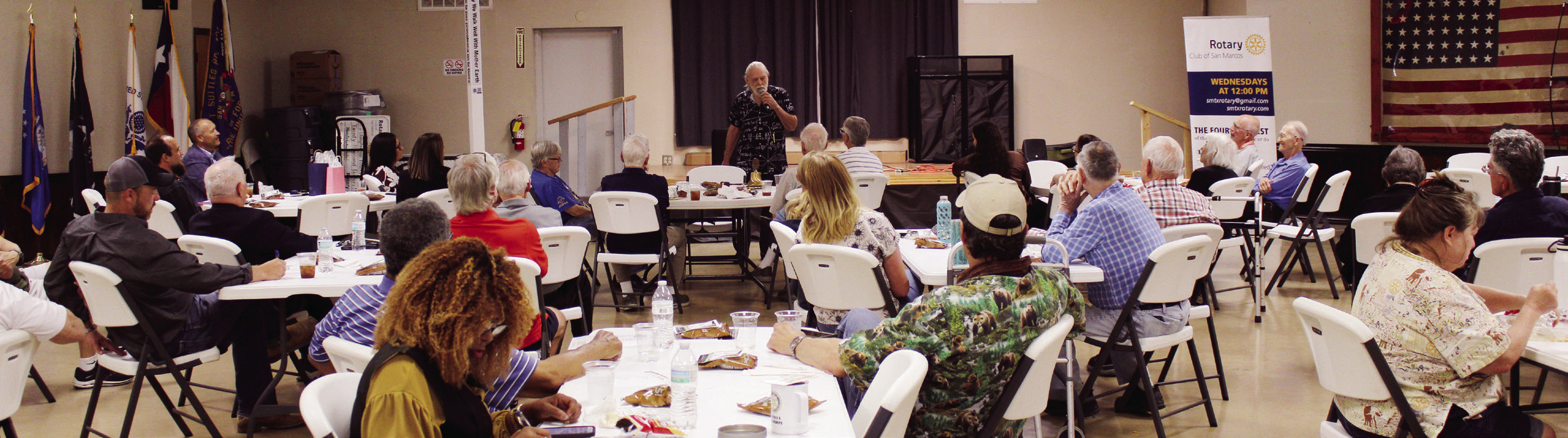
Early speaks to a room full of Rotarians and guests. Daily Record photo by Shannon West