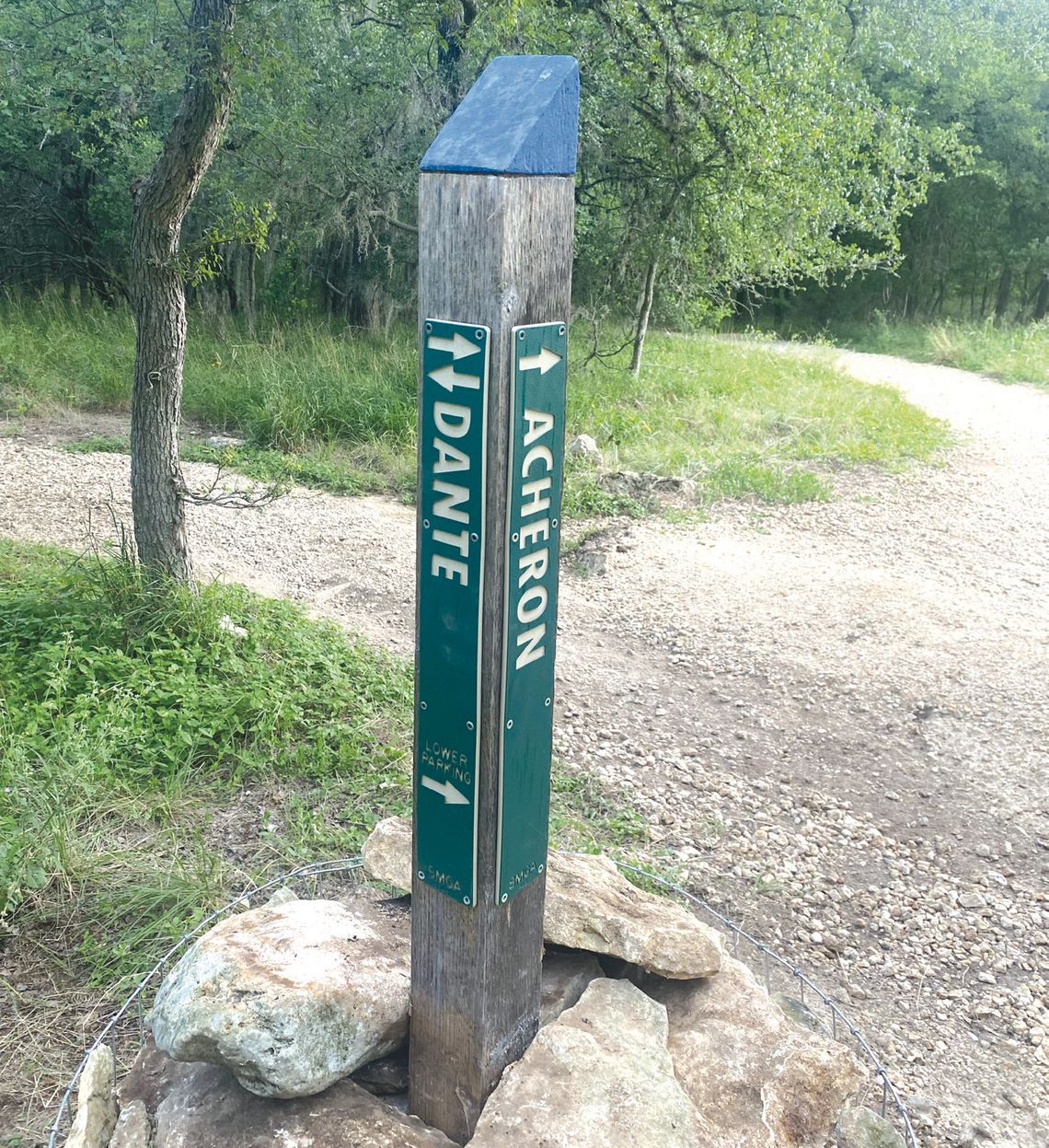
Last week, we began a journey through Dante’s Divine Comedy and our Purgatory Creek Trail system. We left off under Wonderworld Drive, where the Dante Trail intersects with the Virgil Trail. As we move toward Prospect Park, our time on the wide, graded Virgil path is fleeting, and we soon jump on to the more primitive Limbo Loop Trail.
If any of you have an Italian grandmother like me, you’ll know Limbo as the gray place on the edge of Hell where all unbaptized babies go after death. The Roman Church did away with Limbo in 2007, but don’t tell my Nonni, Beatrice Barzetti, or Dante Alighieri that. For Dante, this was the realm of the virtuous pagan, hence his encounter with Virgil. For us, it’s a rocky loop, great for birding and hill country views. Especially nice is the Metz bench where we might stop and read some poems by the other occupants of Dante’s Limbo: Homer, Horace or Ovid, the inspiration for our next trail.
To get to the Ovid trails at Purgatory Creek, we must complete our Limbo circuit and backtrack on the Virgil Trail to return to the Dante Path, which now moves out from under Wonderworld Drive and back toward the dam. Eventually, we come to a dizzying intersection of the Dante Trail, the Ripheus Trail (more on him later), and the Ovid West Trail. In keeping with the path of literature, we jump on the Ovid West Trail here, where, true to its name, an abundance of wildflowers greet us for most of the year.
Ovid’s most famous works are Metamorphoses (Transformations) and Amores (Loves), and these trails, Ovid West and Ovid East, reflect these virtues as they usher us from field to forest, and seasons to season through a wildflower progression that includes Bluebonnets, Firewheels and Turk’s Caps. Yet our time on this trail is short, as we must push deeper into the Inferno, so we jump back on the Dante trail at our next in- tersection, and make for the depths of Hell. Malacoda, the leader of the twelve demons guarding the eighth circle of hell awaits us.

Contrary to the literature, the walk from Ovid to Malacoda is delightful, full of ancient oaks with the raiment of Spanish Moss and the songs of Canyon Wrens echoing along the bluffs. After passing the Beatrice Trail (we’ll come back to her, too), we finally reach the intersection with the Malacoda Loop Trail.
In Dante’s Inferno, Malacoda guards and torments the grafters (those guilty of bribery, political corruption, etc). This altogether rotten character couldn’t be a worse representation of this beautiful loop in the heart of the Purgatory Trail system. Going clockwise, this trail circumnavigates a picturesque meadow between two bluffs, the latter in the rotation, complete with its own massive cavern. If you can get your family to this spot, kids love exploring Geryon Grotto (Geryon being the demon of fraud). However fun it might be to frolic with demons and kids, we must move on to the River Styx if we’re ever going to make it to heaven.
The Dante Trail climbs the bluffs above Malacoda (take the detour to the lookout), before rolling over hill and dale, outcropping and karst on its way to the Upper Purgatory Trailhead. Quite suddenly, we break from the tree cover onto the ADA-compliant Styx Trail, where, without fail, I start singing the 1977 classic “Come Sail Away,” by the band of the same name.
Like Acheron, the Styx Trail derives its name from a waterway in Hades. For Dante, the River Styx marks the swamps of anger and wrath. If we take a right onto this trail, it will deliver us to a low-water crossing, which after a good rain also produces a respectable swamp. However, we turn left and finally turn our faces toward Paradise.
The Styx trail makes a loop, and while either direction suits our needs, the branch to the left offers arboreal delight in the form of two giant live oaks. The second tree can be accessed by a social trail leading through a tunnel of branches and moss. The hollowed giant at the center provides one of the best natural playgrounds in San Marcos. My kids can’t ever get enough, and it’s an easy walk with a stroller from the Upper Purgatory Trailhead. But I digress. At the apex of Styx Loop, we encounter the Paraiso Trail (if we were being true to the Italian literature, this would be the Paradiso Trail, but given we’re in Texas, and this is our Purgatory Creek, the Spanish Paraiso seems appropriate).
Join us next week as we finally reach Paradise and conclude our literary odyssey.