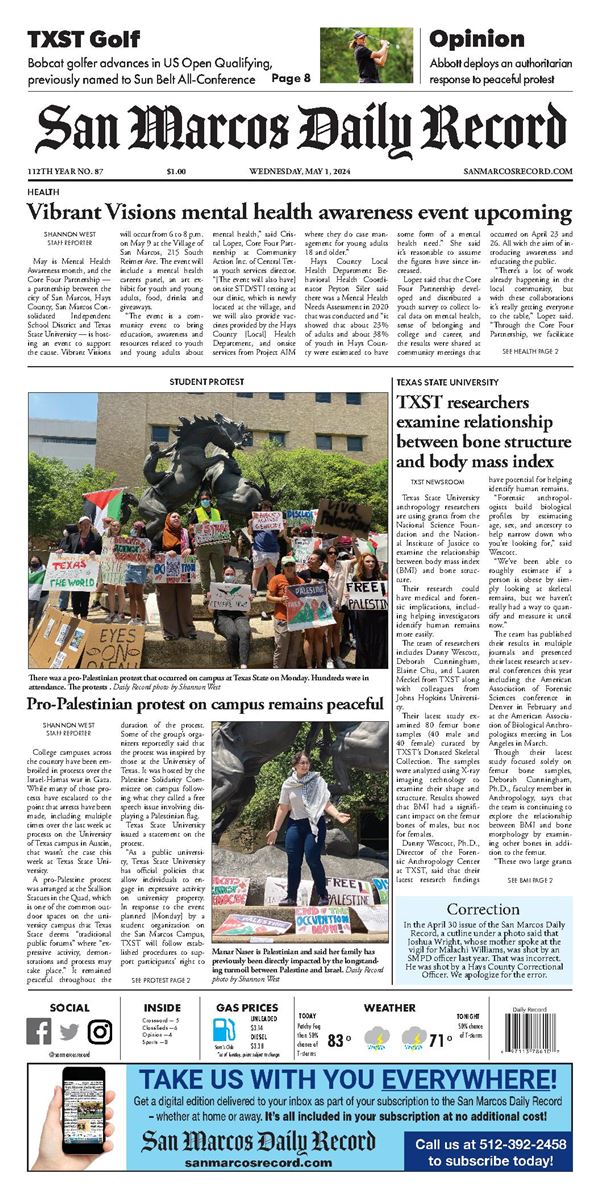
SEARCH AND RESCUE
With the July 4 floods fresh in everyone’s minds and many with boots still on the ground searching for those whose lives were lost to the event, the Rotary Club of San Marcos hosted Tom Roach, a member of the Civil Air Patrol, to learn a little more about some of the heroes doing the difficult, but necessary work. The Civil Air Patrol is a nonprofit U.S. Air Force auxiliary that performs 95% of U.S. inland search and rescue missions.
Roach said that the CAP helped with Hurricane Harvey search and rescue as well as providing needed supplies to survivors.
“I spent almost over a month and a half at this airport from seven in the morning to 11 o’clock at night,” Roach said. “We were doing 80 flights a day toward Harvey. They had over 480,000 structures of property over there. They would go look for people on rooftops, and once they found them on roof- tops, they got a GPS location; They radioed in for help to come and get them. They tried to drop emergency food … clothes and whatever they needed, but the Civil Air Patrol has been real, real beneficial as far as search and rescue. They also do emergency flights of medicine to different parts of the state.”
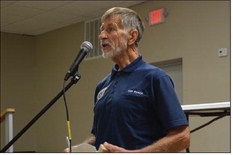
Tom Roach, a member of the Civil Air Patrol, spoke to the Rotary about what the group does. Daily Record photo by Shannon West
According to CAP documents, there are 59,000 members, and, in addition to search and rescue, they perform homeland security, disaster relief and counterdrug missions at the request of government agencies. There are senior members, who must be 18 years and older, and there is a cadet program with 25,000 youth enrolled. If one is not a pilot, they can still participate in other ways such as working with youth, participating in search and rescue or completing required administrative duties to keep the unit running.
“They’re always looking for photographers; it’s very important. When you go up on — they call them a SARM, search and rescue mission — and if you’re looking for somebody … there’s a pilot; There’s what is known as a scanner,” Roach said. “The scanner controls the mission of the flight, and then in the back seat, there’s a photographer. There’s a little glass window that opens up in the plane, and you shoot pictures. It’s not that you see it as you’re flying. But once you get back on the ground, you study these pictures to say, ‘Hey, this might have been here; There’s a backpack, and I’m seeing some shoes.’” Roach said the Civil Air Patrol was the initial group to make use of Waldo — a search and rescue scanning device.
“Waldo is a new thing that sits underneath the wing of a plane. You fly this pattern and Waldo will look through an unbelievable tree pattern or leaves or anything and see people laying there; it can see animals. You can see all kinds of things that the human eye will not see,” Roach said. “You fly down this grid. The next plane flies over their grid, and then you take all these pictures and you compose them.”
Annual membership dues for the CAP cost between $50 to $80, and members are responsible for purchasing uniform items and expenses related to activities, training or conferences. Learn more about the CAP at GoCivilAirPatrol. com
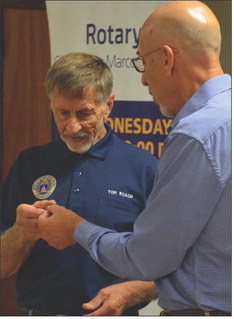
Tom Roach receives a Rotary coin from Sammy Falletta, Rotary Club of San Marcos co-president. Daily Record photo by Shannon West