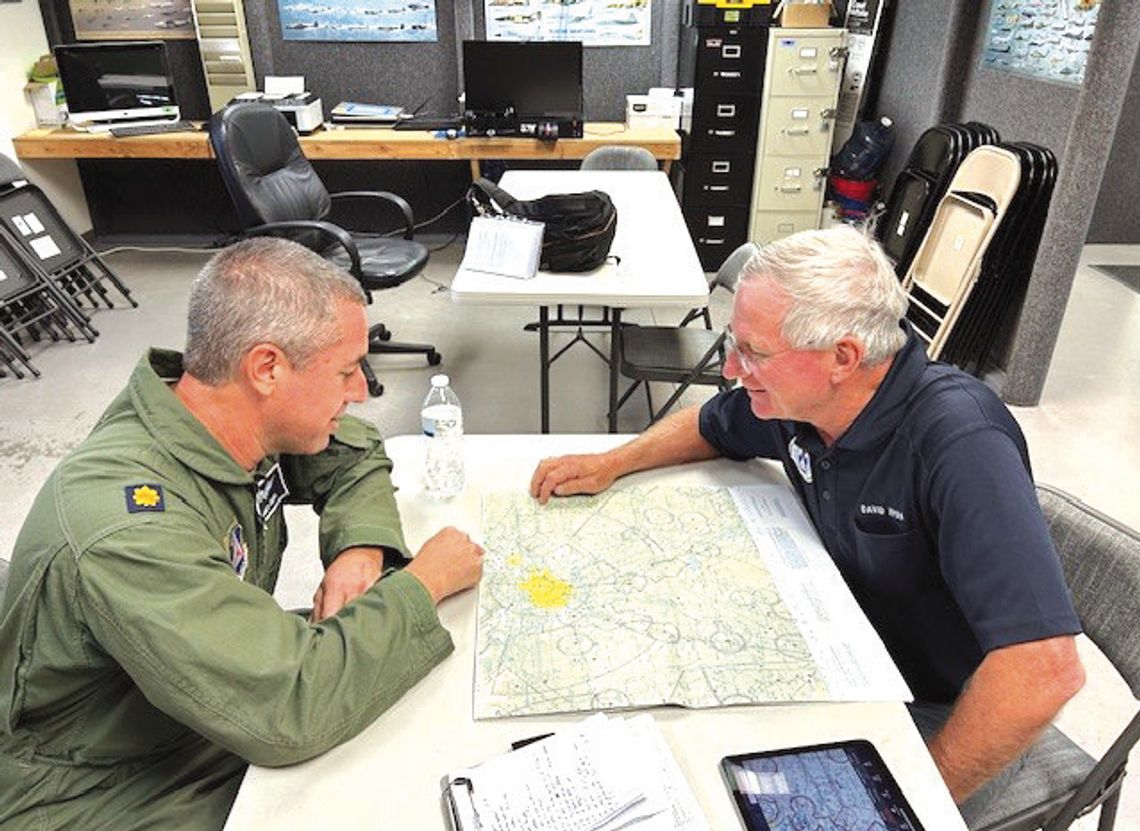
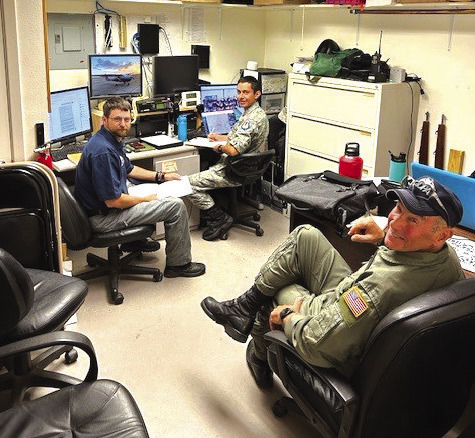
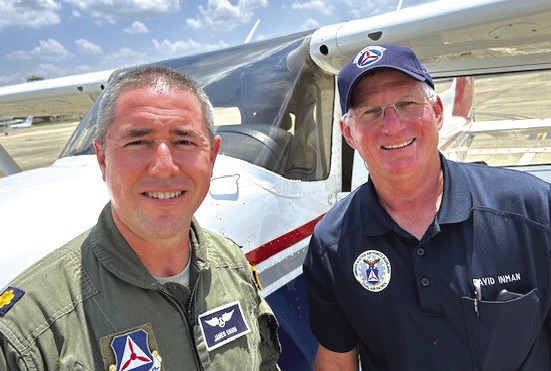
On Saturday, Aug. 16, the Lee ‘Tex’ Hill squadron of the Civil Air Patrol held a Search and Rescue exercise at the San Marcos National Airport. The exercise involved 9 aircrew members who flew 5 sorties on which they practiced various search and rescue techniques. They were supported by 4 mission base staff who provided radio communications and monitored the progress of each sortie.
Saturday’s sorties simulated a disaster response where the crews were looking for stranded people and damage to bridges, towers, and roads. They flew over The Blanco River, the Guadalupe River, the Canyon Lake Dam and other infrastructure.
“We hold an exercise like this every month to ensure we are ready to respond when we are needed.” said Captain Mauricio Urquiola, the squadron Commander.
A typical aircrew consists of a pilot, an observer and a scanner. The pilot’s job is to fly the airplane so that the other crew members have a chance to identify the search objective. Since the typical search pattern is flown at just 90 knots and 1000’ above the ground, the pilot’s most important task is to maximize flight safety. The observer, seated in the co-pilot’s seat, conducts a visual search on the right side of the airplane. They also make radio calls and programs the assigned search pattern into the aircraft’s GPS. The scanner, seated behind the pilot, searches out the left window and uses a special GPS-tracking camera to take photographs.
Lieutenant Colonel Ron Diana, the squadron Assistant Operations Officer said, “A sortie in an exercise only lasts an hour or so but allows the crews to practice every element of a real-world search and rescue mission that might last 3 hours.”
Visit CAP.news or Go-CivilAirPatrol.com for more information. Follow us on Twitter, Facebook, Instagram, LinkedIn, and YouTube.