LETTER TO THE EDITOR
I got the word not long ago that a good friend was gone. To be fair, we hadn’t been close for quite a few years — decades, actually. So the shock of a permanent separation was not what it could have been. Still, it was something that made me question the stability of so much I took – and still take – for granted.
How far back did we go? It was so long that I sometimes think of that span of years as something of a fantasy. “How can I have memories that old?” I ask myself, ignoring the fact that I’m even older than the oldest of those memories. But I can’t come up with a decent answer. I simply tell myself that I’m still here and my friend is not.
I measured much of my young life based on that relationship. It spanned learning to read, as the two of us sprawled out on the living room floor, with the double-page spread of the funnies. It held steady throughout high school. But by the time college rolled around, one of us left for the state university and the other stayed back. So we were only able to catch up when I came home for summer breaks, holidays and the occasional long weekend.
It was always great to get back together again, to find out what was new, who was doing what, who moved away, and get a look at how the hometown had changed. As a poly-sci major, my special interest was government and politics. Or, more accurately, politics and politics and then, maybe, a smidgen of government.
And what a town for it! Back in the day, it had a reputation – some say it was well earned – as one of the crookedest places in my home state. It spawned one of the classic American political bosses, Frank Hague, who was famous for his quote, “I am the law.” This is not to say that Hague deserved sainthood (not by a long shot), but to this day, he still takes a bum rap on that one. The real story (and I learned this from my friend), is that the police picked up a kid for truancy and dragged him in front of the mayor. The kid explained he was trying to find a job to help support his family. The truant officer jumped in and said, “But the kid was breaking the law, he’s too young to get a job.” “The law?” asked Hague, “The law? In this case, I am the law! Let that kid go and find him a job.”
My friend had a lot of stories, not quite the 8 million of “The Naked City,” but, believe me, a lot of stories—and some pretty good ones. He’s gone now, and with him, far too many stories. He passed away quietly on a quiet Saturday in February. Age? Well, let’s just say old enough to know better.
It’s not like new stories aren’t happening all the time. But my friend’s not here anymore to listen to mine or tell me his. And that’s a shame. His name? The Jersey Journal — the local newspaper when I was growing up.
Back when he and I spent time together every day, he opened the world up to me in a way that the classroom never did. You see, I knew the people in these stories. They were friends, neighbors, relatives, teachers, local merchants, and sometimes my friends.
I’d get excited when “Mr. Fixit,” the column that helped folks solve problems with government bureaucracies, fingered my old man, Jimmy Leonard, as the guy to call, particularly for veterans with problems. I’d read about my neighbor, the fire fighter, a genuine hero who saved a family from a burning apartment above the local toy store. I’d read about meetings of organizations with important names that did important things. I’d pester my grandmother when I saw that the local five and dime was having a sale on model airplanes.
I learned not only who won our county in the latest presidential election and how my neighborhood voted, but how the electoral vote worked (or didn’t). On Saturdays, I’d check out the church listings to see which pastor promised the most interesting sermon on Sunday morning—always hoping it would be mine. And, of course, my favorite part of the Saturday paper: the weekly roundup of carefully curated political gossip.
Most importantly, I came to understand all of the elements, some working in synch and some not, that were so important to the concept of community. And thinking about it today, I wonder how that would have happened without my countless hours with The Jersey Journal.
Its mourning period was short. It was there on a Saturday and gone on Monday. The owners didn’t even set up a website. They simply pulled the plug. One consolation? The city demanded that when the old building was torn down, the developers retain the front entrance of the old newspaper building, along with the words “The Jersey Journal” carved above the doors.
But my story is not about Jersey City or The Jersey Journal, although, in the Journal’s heyday, it could have been the story of any city of a certain size. After all, most of them had their own newspaper —sometimes more than one. No, this story is about how newspapers shaped the perception of the world, and what was important and what wasn’t.
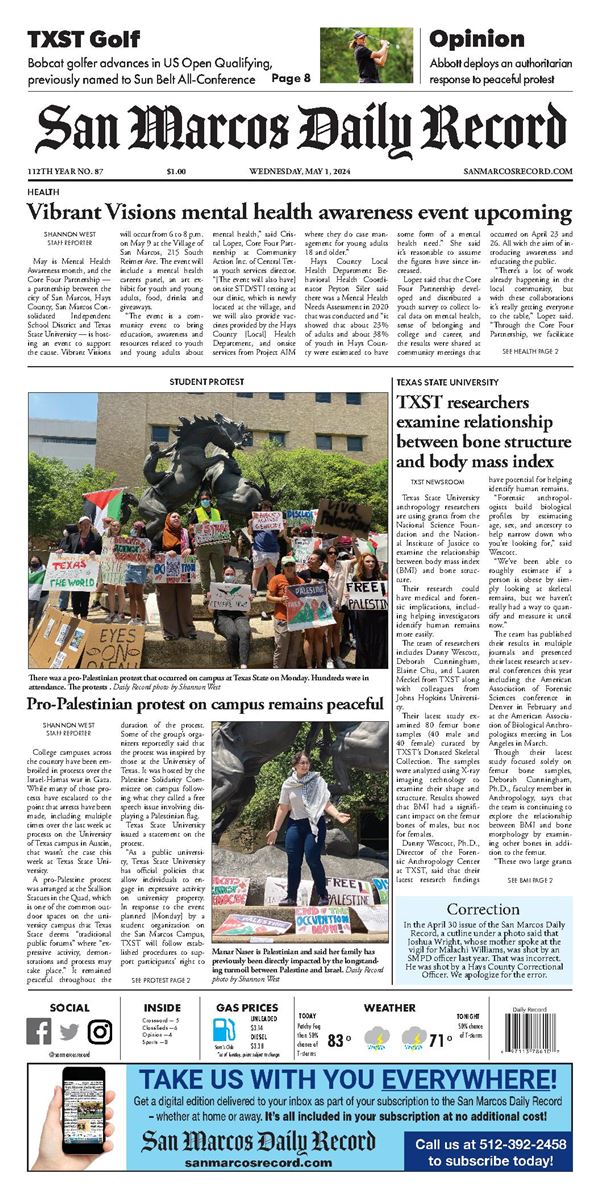
Ultimately, it’s a story about how fortunate we are in San Marcos. Like Jersey City, which is sandwiched between two major media markets, New York and Philadelphia, San Marcos is smack-dab between Austin and San Antonio. That means the news coming out of the bigger cities dominates the news. San Marcos and Hays County may get a mention if the story’s big enough. But for the work-a-day happenings, the stuff that keep the wheels turning — civic activities, government meetings, budgets and tax rates, school sports, local elections, new businesses, volunteer activities, and, yes, the life stories of those who have left us — we’re not going to get those stories in the big-city media. But we are going to get them in the San Marcos Daily Record.
The newspaper business is tougher than most these days. Free online content has taken a whack at just about every form of traditional publishing. If you’re like me, you realize that, unlike a newspaper (or a newspaper’s web site), there is no comparable one-stop local information source. And if you’re reading these words, you also know that much of the content covered locally in the Record, just isn’t covered anywhere else. You’re investing your time and the cost of a Daily Record subscription, not only in the future of this newspaper, but in the future of our shared community.
In a week that would make colonial publisher John Peter Zenger proud, your support of the San Marcos Daily Record is an endorsement of the concept he pioneered when, after being jailed for almost a year, he stood up and successfully defended the proposition of an American free press in 1733.
You’re in good company! Sincerely, Jon Leonard San Marcos