LETTER TO THE EDITOR
To the Editor:
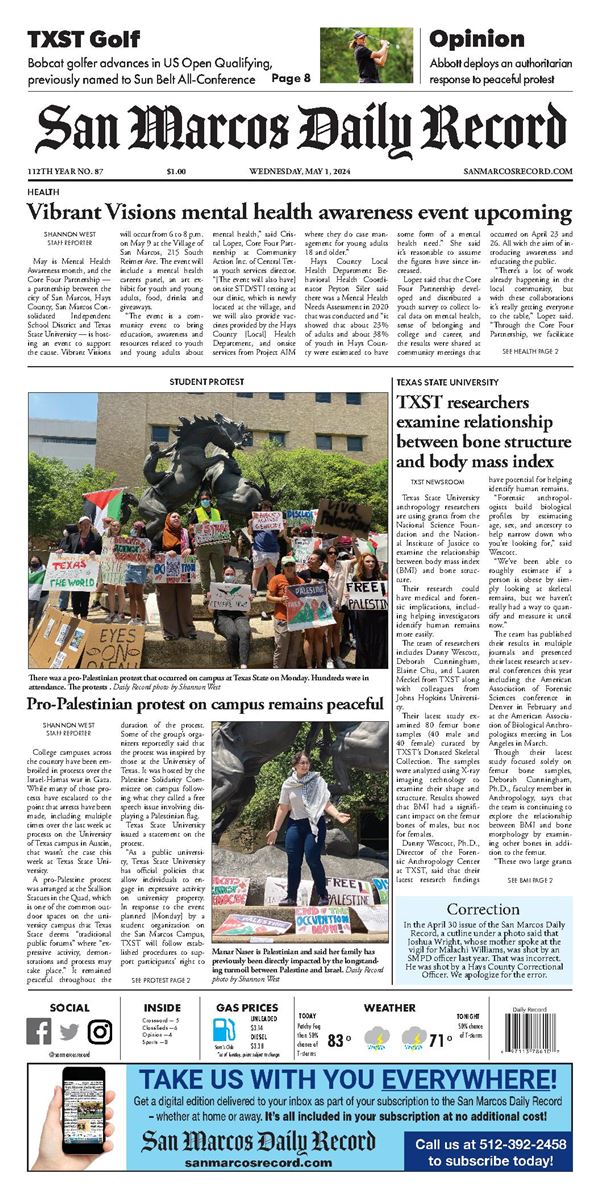
Texas State University President Kelly Damphousse is in a difficult political position. Gov. Abbott has appointed all of the university’s board of regents. If Damphousse doesn’t do what Abbott wants, his head may be next on the chopping block. So far, when Governor Abbott says jump, Damphousse asks, like the proverbial frog, “how high?”
The recent responses to Abbott demands started with the removal from campus of a student who mocked the killing of Charlie Kirk. It is not clear if the student was expelled from the university or left voluntarily under pressure. However, it is beyond debate that the student’s behavior fell squarely within the free speech protections of the First Amendment. No matter how Abbott felt about the mocking by the student, Abbott was clearly demanding a violation of the First Amendment’s free speech protections when he wrote “Expel this student immediately. Mocking assassination must have consequences.”
If free speech has any substance at all, it must include expressions that offend other people. What use is free speech if all we can do or say is what pleases government officials? Speech that offends or outrages others, including high government officials, is one reason our founders included free speech protections in the First Amendment.
Damphousse doesn’t seem to understand that concept any better than Abbott. Damphousse said in a formal statement, “I will not tolerate behavior that mocks, trivializes, or promotes violence on our campuses.” But the First Amendment is precisely aimed at speech (including symbolic speech) that offends state university presidents and governors. It protects us from public officials who act like they are more powerful than our laws and the Constitution.
This sordid, impermissible affair was followed by the summary firing of tenured professor Thomas Alter on Sept. 10, after it was learned that he made comments disliked by both Abbott and Damphousse in an online socialist conference that the two government leaders believed advocated violence. Alter commented about what he termed “insurrectional anarchists,” saying, “while their actions are laudable, it should be asked, to what purpose do they serve?” But the video that went viral on social media had only the second half of Alter’s idea, where he said, “without organization, how can anyone expect to overthrow the most bloodthirsty, profitdriven, mad organization in the history of the world — that of the United States?”
While those latter comments may find widespread disagreement among most Americans, they are precisely the kind of free speech guaranteed by the First Amendment. If we can’t say something that is disagreeable or offensive to others, we cannot reasonably call our right free speech. Later, Alter supposedly received the due process to which he is entitled and was once again fired, an action tainted by his first clearly illegal and unconstitutional firing. A famous case in American free speech jurisprudence is Brandenburg v. Ohio (1969), in which the Supreme Court considered the punishment of a Ku Klux Klan leader who, at a KKK rally, advocated terrorism as a means of political reform. The court quoted some of its earlier decisions which held “the mere abstract teaching . . . of the moral propriety or even moral necessity for a resort to force and violence is not the same as preparing a group for violent action and steeling it to such action.”
Another case held, “A statute which fails to draw this distinction impermissibly intrudes upon the freedoms guaranteed by the First and Fourteenth Amendments. It sweeps within its condemnation speech which our Constitution has immunized from governmental control.”
Writing about the law in Ohio under which Brandenburg was convicted, the court wrote “The Act punishes persons who ‘advocate or teach the duty, necessity, or propriety’ of violence ‘as a means of accomplishing industrial or political reform’; or who publish or circulate or display any book or paper containing such advocacy; or who ‘justify’ the commission of violent acts ‘with intent to exemplify, spread or advocate the propriety of the doctrines of criminal syndicalism’; or who ‘voluntarily assemble’ with a group formed ‘to teach or advocate the doctrines of criminal syndicalism.’ Neither the indictment nor the trial judge’s instructions to the jury in any way refined the statute’s bald definition of the crime in terms of mere advocacy not distinguished from incitement to imminent lawless action.”
Without question, Professor Alter was not inciting anyone to “imminent lawless action.” He was commenting on his analysis of people of a particular political viewpoint and the condition of the United States from his perspective.
In Watts v. United States (1969), the Supreme Court again considered when inflammatory speech loses First Amendment protection. It held that threatening speech can be protected unless the statement constitutes a “true threat.” To determine if a statement is a true threat depends on factors including the context of the statement and its reception. Nothing about Alter’s opinion about anarchists and the U.S. government fits the definition of a true threat.
And in National Socialist Party of America v. Village of Skokie (1977), the Supreme Court held that offensive, even hateful speech is protected unless it falls within one of the special categories of speech not protected, such as true threats and speech that tends to create an immediate breach of the peace, often called “fighting words.”
Neither the behavior of the student who infuriated Abbott and Damphousse, nor Alter should be punished for their exercise of free speech, even if one considers it hateful speech. Whether Abbott or Damphousse or any citizen is offended by or objects to Alter’s and the student’s views, they have an absolute right under the First Amendment to express them. The remedy for speech that one doesn’t like is, and always has been, more speech to express opposing views.
It takes government officials of strong character, principle, and honor to uphold the First Amendment rights of our citizens, including students and teachers, when they promote what may be unpopular ideas. Readers can judge for themselves whether Gov. Abbott and President Damphousse have those qualities of leadership.
Lamar W. Hankins San Marcos