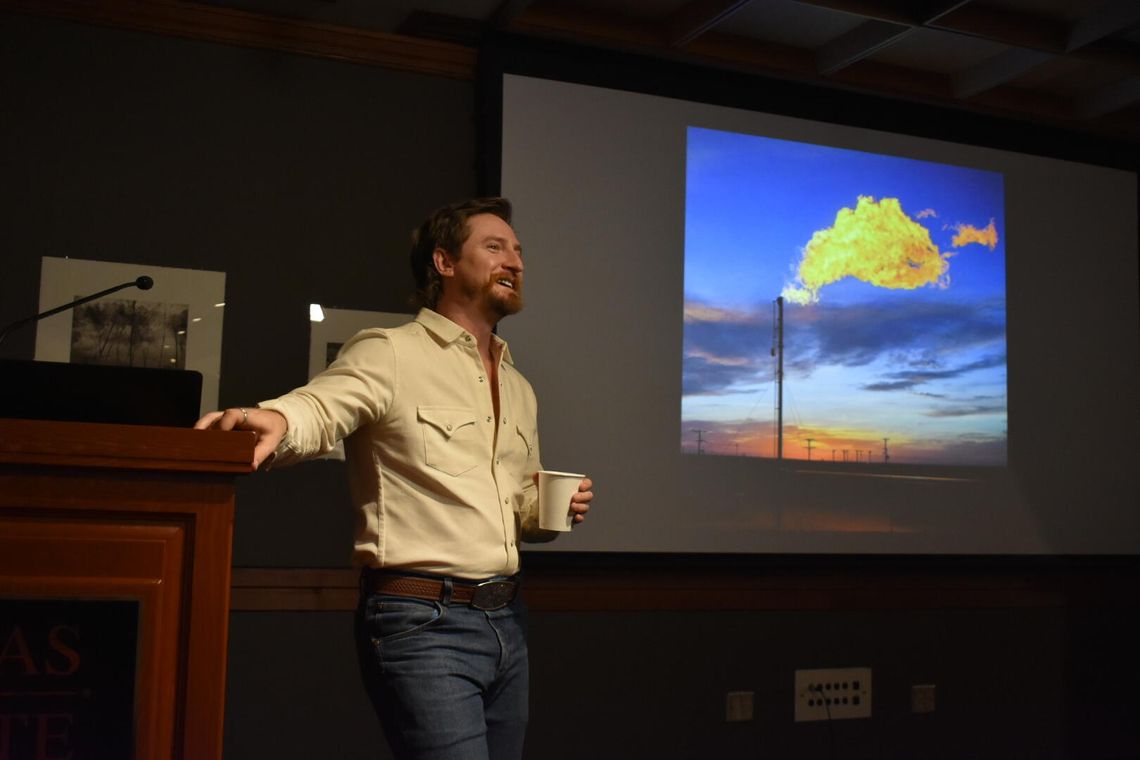
From Texas State to Texas Monthly and now TV, Christian Wallace has written his way from the flat plains of West Texas to the peak of Paramount. To celebrate his success, The Wittliff Collections hosted an event that brought Christian’s words off the page and into the hearts of the crowd.
The seventh floor of Texas State’s Alkek Library was packed with students, fans and community members curious about Wallace’s writings. After an introduction from his former professor and Dean of the Honors College, Heather Galloway, Ph.D, Wallace took the crowd through his journey from growing up in a small oil town, to college in San Marcos, to the archives of Texas Monthly, back to West Texas for his groundbreaking podcast “Boomtown” and to millions of TVs across the world who tuned into “Landman,” the Paramount+ show co-created by Taylor Sheridan and Wallace. That same night Wallace was awarded the Young Alumni Rising Star Award from TXST.
During his time at Texas State, he immersed himself in the History and English departments, as well as the Honors College, taking 13 honors courses over his college career. Growing up in West Texas Wallace knew he wanted to pursue college, securing a full ride through The Terry Foundation scholarship. His sights landed on San Marcos after he drove the six hours from his West Texas home to Cheatham Street Warehouse for a high school project. The historic honky-tonk became the focus of his Honors Capstone project as well as a feature in one of his Texas Monthly articles.
“I think that the highest thing I can say about Christian Wallace is that he is the only person I know that has earned high school, college and salary from hanging out in places that sell beer and have great music,” Galloway said during her introduction.
Wallace prefaced his talk by saying that he’s not a big fan of talking about himself and gave props to the people who helped him along his journey, including his librarians, teachers, parents, grandparents, mentors and friends. He grew up in Andrews, an oil town just over 100 miles south of Lubbock and only 30 miles from New Mexico.
“What happens in this part of Texas affects people all over the world in a very visceral way, and yet the region is largely overlooked and not well understood by outsiders,” Wallace said.
He described the physical differences of the land, comparing the calf building hills at Texas State to the flat land in West Texas.
“It’s so flat out there you can see for miles and miles and as the saying goes, ‘If you stand on a tortilla, you can see 100 miles more,’” Wallace joked.
Although we use oil everyday, from fueling our cars to maintaining the roads we travel, it’s easy to overlook this common commodity. Oil is a familiar concept in his hometown, with the nod of pumpjacks being a consistent sight for locals.
“Folks from the Permian tend to have a different relationship to oil than most people in other parts of the world, the towns live and die by the price of oil,” Wallace said. “Booms and busts are what shape my town and the lives in it, and that closeness to this black liquid that powers our modern world, for better and for worse, has profoundly shaped me as a storyteller.”
Wallace grew up during a bust period, where more people moved out than into his small town. Although his parents didn’t work in the oil field, much of his family worked in the oil patch. As a kid Wallace was more interested in libraries than liquid gold. He spent hours amongst the pages but one afternoon after flipping through a C.S. Lewis book he was struck with a profound experience. The character in the novel had traveled through the hot desert and reached an oasis where he dined on cold sherbert.
“I didn’t even know what sherbert was, but I tasted something cold and delicious in my mouth, and those words on the page had transported me. They had made me feel something and literally taste something, and that is basically what I’ve been chasing ever since,” Wallace said.
From that point on the power of words was his motivation, letting anyone who asked know that he wanted to be a writer when he grew up.
After working hard in high school and securing a full ride scholarship, Wallace was faced with the task of deciding where to go to university. When visiting San Marcos for his class project he was intrigued by students floating in tubes and the tunes of Texas musicians at Cheatham Street.
“I can get a good education at any of these Texas universities, but only Texas State has that river and that honky-tonk down the road,” Wallace said.
Cheatham Street became a pivotal place for Wallace during his college years. It’s where he formed close friendships with music lovers and even Cheatham Street founder and songwriter Kent Finlay. He focused his Honors Capstone, which functions as a thesis project, on the honkytonk that held such an important part in his life.
As a writer Wallace got his wings starting at Texas State’s newspaper, the University Star. His college career took him to Ireland for graduate school.
“Something shifted in me while I was there, I started to miss West Texas, the people, the food, even the tortilla-flat horizons and the pumpjacks that bend their heads like horses going to water,” Wallace said. “This was really where for the first time my sense of place began to take shape, and where I began to start taking ’home’ in storytelling seriously.”
His graduation aligned with an oil boom in his small Texas town. Wallace followed the calling and returned home to Andrews where he worked as a roughneck in the oil fields. Although he had grown up around oil production his whole life, it wasn’t until he worked in the industry that he began to understand the scope and complexity of the oil business.
“I gained a profound appreciation for those who work in the field, and it’s not just brutal grunt work, it’s actually highly skilled tradesmen doing incredible jobs to keep things running out there,” Wallace said.
He found his way back to San Marcos where he landed a gig as a Texas Monthly intern, giving hours of his life to transcribe old articles and interviews, bringing old print words back to life through a digital archive. He began pitching his own stories to the monthly magazine and landed a full-time job as a fact checker. His beginnings at Texas Monthly, transcribing and fact checking acted as a continued education, allowing Wallace the opportunity to learn the ropes of journalism and the art of crafting a compelling story. These skills landed him a cover story and then many more after that.
His stories started to gain the attention of Hollywood, with production companies interested in bringing his words to the big screen. While navigating the ups and downs of the production process Wallace came across fellow TXST alumni Taylor Sheridan’s scripts and was impressed with his storytelling. Wallace placed one of his Texas Monthly stories in an envelope and sent it to Sheridan without much hope of hearing back. Months later Wallace received a call from Sheridan, who was intrigued by the story but was currently working on the TV show “Yellowstone.”
In 2018, Wallace worked on an article about the oil boom in his home of West Texas.
“I was proud of the work, but that article that I did barely skimmed the surface, and I got the chance to do that when Texas Monthly partnered with Imperative Entertainment to launch a new podcast,” Wallace said. “Myself and other Texas Monthly staff writers, pitched ideas for a narrative documentary series, and my idea about the West Texas oil boom ended up being the one that moved forward.”
For the next half year Wallace drove around the Permian Basin with a microphone, interviewing anyone and everyone involved in the oil business and the town supporting these industries. This became the podcast, “Boomtown.”
“Podcasts are a unique medium. They allow the subjects to speak for themselves, to use their literal own voices to tell their stories, and I knew how special those voices were,” Wallace said. He understood this new medium would only thrive if he took a personal approach, interviewing family and friends to create a podcast that was deeply rooted in experience and community.
“Boomtown” blew up. The podcast topped the charts, with millions of listeners traveling along with Wallace as he shared his home and the people who keep the trillion-dollar industry afloat.
Wallace received a phone call from Taylor Sheridan and over the next three years they talked about how to turn the podcast into a show. Wallace is credited as the co-creator of “Landman,” which skyrocketed in the ratings as well, becoming the most-watched Paramount+ original series at the time. Much of the show is based in the lived reality of Wallace and those of West Texas, from devastating oil industry accidents to drive-through bikini baristas, the truth made for compelling TV.
“The fiction lives alongside the truth, and that’s one of the things I love about West Texas. Out here, myth and reality often wear the same pair of boots,” Wallace said. “At its heart, “Landman” is about many of the same themes I first chased in “Boomtown,” ambition, survival, loyalty to place and family, and the question of what we’re willing to sacrifice to make a living and to power the world.”
The crowd at the Wittliff hung on every word.
“I hope that “Landman” is a starting point for deeper conversations about energy and the future of West Texas. I hope that it shines light on the people that risk so much so that we can enjoy the many conveniences of the modern world. And I hope that it will inspire others to create art about their version of this place or their own overlooked corner of the world,” Wallace said.
“Landman” season two streams November 16 on Paramount+. Find more of Wallace’s work on his website at christianhwallace.com or at a local honky-tonk where he might be sipping a beer and seeking his next story.