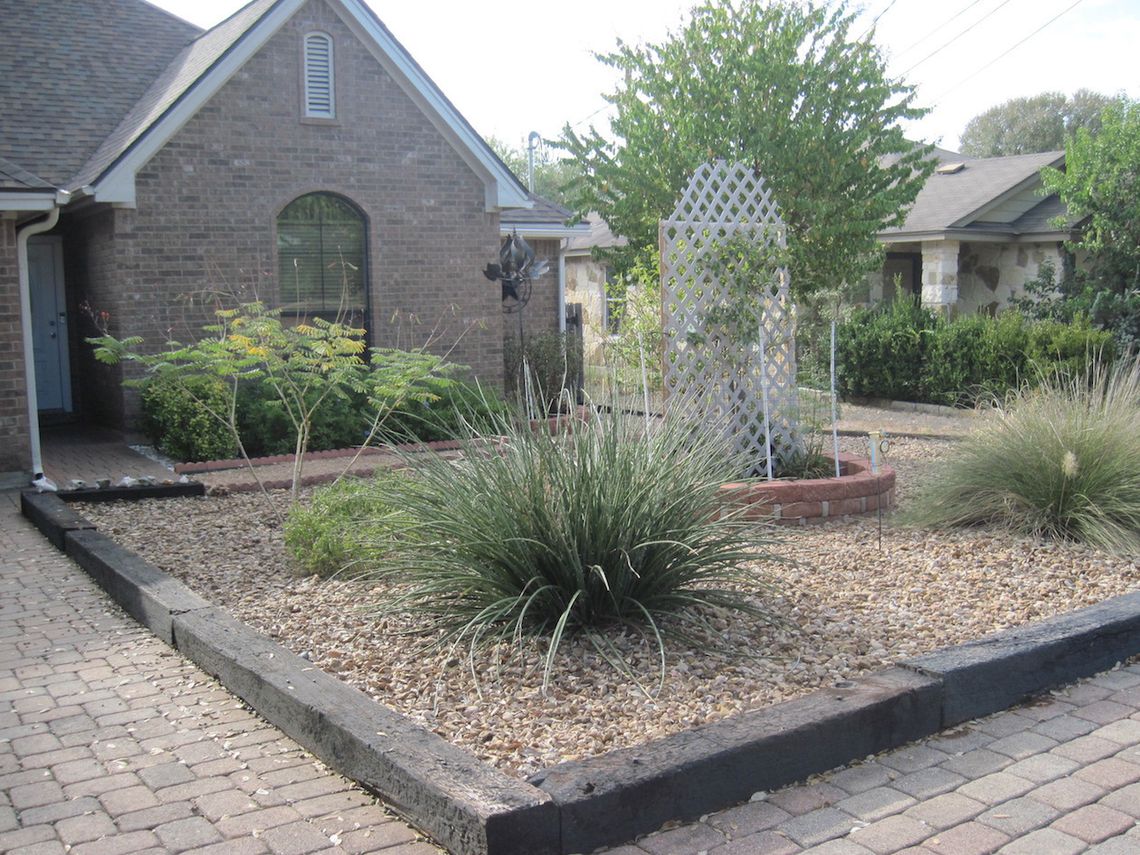
Rainless weather is a true test of any xeriscape (not a “zero-scape”), featuring plants adapted to a “xeri” or dry environment, and the Griffith home on Stonehaven in Castle Forest is a showcase of successful landscaping without regular irrigation. After moving here six years ago, Gary and Martha Griffith transformed a gravel-covered front yard edged with railroad ties into a balance of hardscape textures and plant forms, inspiring compliments for an unusual but attractive landscape.
Instead of simply replacing a dying tree in mid yard, Gary added to the area’s interest with a brick circle and white trellis for a climbing rose, bordered with dwarf yuccas. Protected from browsing deer by a wire mesh enclosure, the rose blooms white, contrasting with colored blossoms on another rose in a bed nearer the house. Without shade from a tree, the front yard became a perfect setting for xeric plantings of dark green Texas sotol, feathery muhly grass, variegated blossom lantana, and a hardy Pride of Barbados near the entry. Filling out the square is a holly bush which produces red berries, a mound of pale green pampas grass, and a crape myrtle tree (pink blossoms), not a Texas native but an adapted favorite in central Texas landscapes.
Contrasting plant forms enhance any xeriscape, but ground covers are also part of the plan. When the Griffiths arrived, the light brown rock covering the front yard contrasted with darker brown pavers used for the adjacent driveway. Gary added a walkway of beige pea gravel between the xeriscape area and planting beds along the front of the house, edged with scalloped pavers. He mulched this bed with stark white gravel, also used to cover ground between the front sidewalk and curb. The foundation plantings include golden euonymus and plumbago with pale blue flowers, ending with the second rose bush.

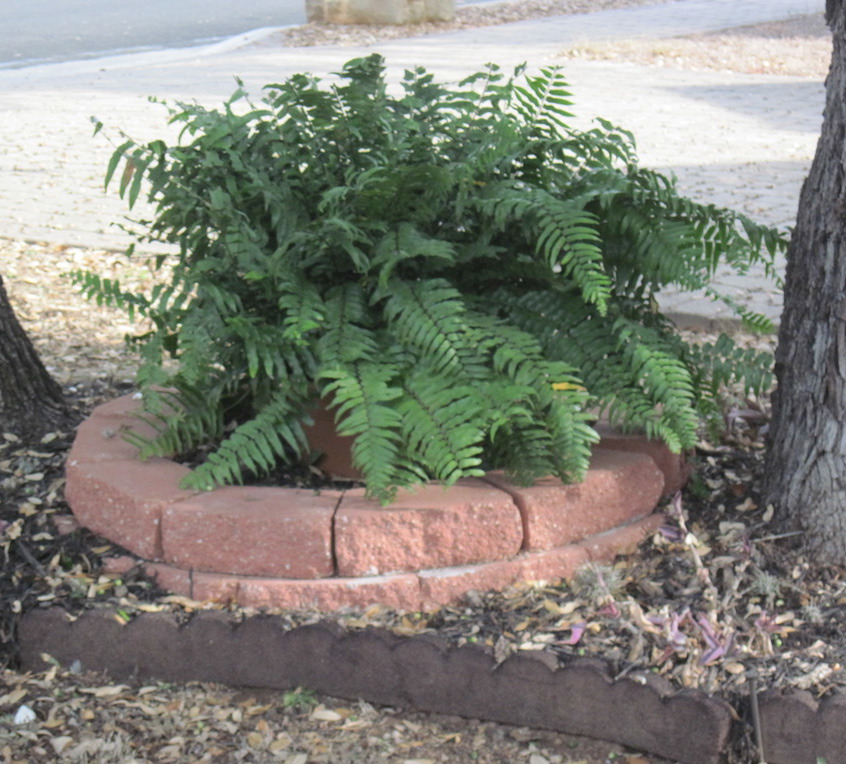
Gary built a second brick circle in the nextdoor neighbor’s side yard (with permission) to enclose a hardy fern that thrives in the shade of two large oak trees another example of successful xeriscaping, or matching plants with their environment. Dry shade is another opportunity for xeric landscaping.
Railroad ties enclosing the xeric area were treated with a tar solution to maintain their integrity, and the dark surface now offers a contrasting background for a collection of decorative rock specimens and blanched shells. Two yard ornaments echo the Griffiths’ earlier involvement (over ten years) with sailing. A metal wind vane with a ship silhouette marks the front of the yard, and a large metal compass icon hangs on the garage wall near the entry. A candle wind vane, whose center rotates independently of its outer rim, is another reminder of a connection with wind and weather, common to both sailing and xeriscaping.