OP/ED
The College Football Playoff bracket was finally revealed last Sunday following plenty of scrutiny over the past months.
The end result that caused the most buzz was the inclusion of two Group of Five champions. Tulane and James Madison made the field, edging out some of the most storied programs in college football history, including Notre Dame.
The revelation of two Group of Five champions making the College Football Playoff caused plenty of vitriol among the starry-eyed college football media types towards mid-majors, to extreme levels. Many want these mid-major programs excluded from the playoff entirely.
The truth is, it has never been harder to be a Group of Five program than in the current era of college football.
Each passing year, critics of the Group of Five seem to get louder and more angry at the existence of these teams, which play on the same level as the traditional blue bloods like Alabama, Georgia, Ohio and Texas.
The Group of Five programs also find themselves fighting for the scraps on live television with, many teams having to play on a different day than the traditional Saturday kickoff just to be on ESPN, while the likes of the SEC and the Big Ten rake in millions of dollars from their television contracts.
To compound all of it, the combination of NIL and the Transfer Portal has wreaked havoc on the sustainability of these programs.
Arizona’s leading rusher? Ismail Mahdi, a transfer from Texas State. Missouri’s leading rusher and second in the nation in rushing yards? Ahmad Hardy, a transfer from Louisiana Monroe. Vanderbilt quarterback Diego Pavia? A transfer from New Mexico State. Ole Miss quarterback Trinidad Chambliss? A transfer from Ferris State.
So while the critics and fans of Power Five programs love to degrade the Group of Five, they are also more than happy to pick up both players and coaches from said programs.
Even with all the challenges set upon the Group of Five, these programs have still found ways to succeed in spite of these seemingly insurmountable odds.
It is not Tulane’s or James Madison’s fault that the College Football Playoff is structured how it is.
Conference realignment has bloated the Power Conferences into something unrecognizable, with 16 or more teams populated each conference.
With only 12 games on the schedule, and eight to nine being conference games, it is impossible to gauge which are truly the best teams in the conference. The ACC didn’t have its best team, Miami, play in a conference championship. Texas A&M only played one team inside the top six of conference play. Ohio State missed Indiana and Oregon entirely in conference play.
But instead of pointing the finger at themselves on why the College Football Playoff is the way it is, the blame has somehow shifted towards the Group of Five programs for a mess they didn’t create.
A talking point around college football that has come up is the need for the power conferences to separate from the Group of Five, essentially creating an FCS 2.0 league.
The idea for separating the Group of Five from the Power Conferences is nonsense. Comparing FBS to UIL 6A football, Texas High School Football is not better off as a super league of the top blue bloods in the state playing each other.
Much like Texas High School Football, FBS is unique because it stretches coast-to-coast, bringing together people from different backgrounds who may never meet otherwise. While Texas and Texas State may be viewed as playing on different levels, the game of football is still played with one program’s best 11 players against another’s best 11 players.
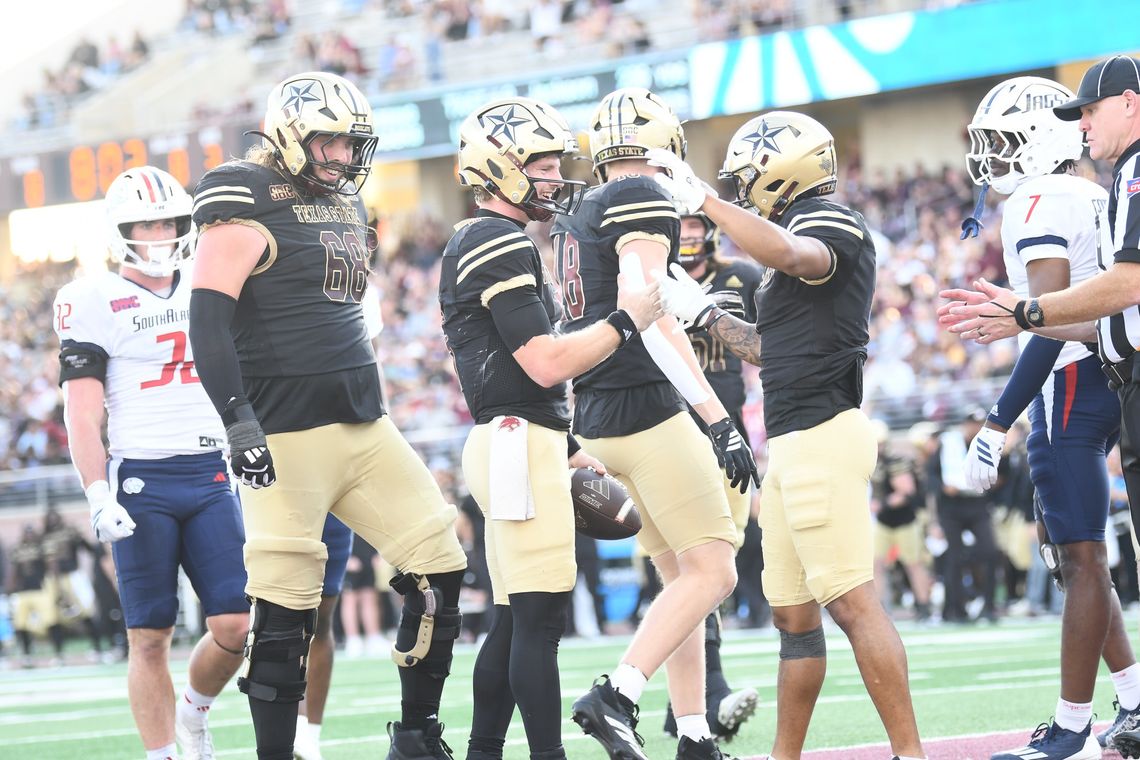
The Group of Five will continue to trudge through in spite of everything seemingly against their progress. Even with less money, after having many of their most successful players and coaches poached, the Group of Five schools are still trying to crash the Power Four’s New Year’s Eve party. This year, maybe Tulane or James Madison will do it. Maybe next year it will be Texas State.