CITY COUNCIL
The San Marcos City Council chose to send a letter of support for the nomination submitted by the nonprofit Preservation Texas to the Texas Historical Commission for the addition of Cape’s Dam and Millrace to the National Register of Historic Places. Sam Aguirre, the city attorney, made clear that if the designation were awarded it would carry more political than legal weight when it came to whether or not the dam could be removed. It could still be removed in the future.
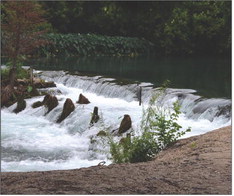
Cape’s Dam and its associated Mill Race channel are a topic of great contention in the community. The Mill Race is manmade but has become a habitat to many underwater species; however, it lessens the flow of the main river channel by redirecting some of the water. San Marcan’s have been split on what to do with the dam since 2013. Cape’s Dam itself is in a poor state as is. There are pieces of rebar jutting from the riverbed, and a 17-year-old drowned in 2024 after getting caught in it, according to previous reporting by the Daily Record.
City documents state that the city was required to make a decision on whether to support the nomination by Jan. 16. The nomination was discussed at the Historic Preservation Commission meeting on Dec. 4.
“The Commission expressed that while they believe the dam qualifies as historic, they have concerns about its integrity,” city documents state. “They noted that although the property is old enough to meet the criteria for historic designation, the dam may no longer retain enough of its original appearance. Additional concerns were raised regarding property boundaries and ownership were discussed.”
The dam is currently undergoing a feasibility study, approved in March, that will “evaluate current conditions of and the safety, environmental historical and recreational aspects,” according to the city website. The next phase is for the contracted company to present three conceptual alternatives for the dam, which include repair, partial removal or full removal.
All member of the council agreed that the site had historic value, but some took exception to how the specifics were stated in the nomination. A point of disagreement among the community is if slaves were used to construct the dam. The application submitted to the Texas Historical Commission by Preservation Texas credited enslaved African Americans for building the dam.
“[Thompson] negotiated an agreement with Davis and another landowner, John Francis McGehee, to construct a dam at this site. Construction commenced in late 1850 when enslaved African American laborers hand excavated a millrace and wasteway,” the application states.
San Marcos City Council Member Amanda Rodriguez took issue with the narrative crafted in the application.
“There’s just some really interesting takes found throughout this entire application, really essentially arguing that had it not been for white settlers, the land and its people would have been ... destitute. And that’s a very familiar and harmful lie that I’ve seen quite often,” Rodriguez said. “I’m not denying the historical nature of this, but … I just feel that there’s a whole piece of the pie missing when it comes to the use of enslaved labor and the celebration of the people who were [slave owners].”
Rodriguez was concerned that the city’s letter of support would be attached to the same file as the application, possibly implying that the council is confirming the history as written in the application.
Rodriguez asked that the letter “expand upon the history to accurately reflect the contributions of those enslaved towards building this thing.”
San Marcos City Council Member Alyssa Garza said she would not be voting in support of the item but recommended adding this language to the letter: “While the City Council supports the nomination to the Thompson-Cape Dam and Millrace to the National Register of Historic Places, we also recognize that interpretations of the site’s history have generated differing perspectives, including questions about the role of enslaved labor in its construction and operation.”
The city’s letter of support now has the statement written by Garza, a sentence stating that the city is not the sole owner of the property, and an acknowledgement of the general historic information such as when it was built and that it was the first industry in the area.
The council members in favor of recognizing the historical significance were concerned that if the council did not submit a letter of support, it would appear as if they were against the recognition all together. The council approved the submission of the letter of support with Hughson, Matthew Mendoza, Shane Scott and Lorenzo Gonzalez voting in favor. Rodriguez, Garza and Saul Gonzales voted against the measure.