
CITY OF SAN MARCOS
The Maberry Data Center was back before the San Marcos City Council Tuesday prompting hours of public comment, the majority of which was opposed to the project.
Those speaking against the data center cited the use of large amounts of water and electricity, in addition to the impacts of industrial uses on neighboring properties and people.
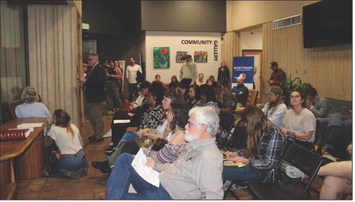
There was no action taken at the meeting on the data center, as it was a public hearing to seek feedback on the proposal. The first vote is expected to occur at the next meeting on Feb. 17.
According to city documents, John Maberry, the landowner, has requested to change the city’s Preferred Scenario Map for 200 acres at 900 Block of Francis Harris Lane from “Conservation/ Cluster” to “Commercial/ Employment Low” — a designation San Marcos Planning and Services Director Terry Floyd said is primarily “characterized by light-to-heavy industrial, warehouse, distribution or lower density office” developments.
City documents state that the Preferred Scenario Amendment (PSA) was previously denied by the Planning and Zoning Commission, which meant that the council would have needed to have six affirmative votes to reverse the decision. The council voted 5-2 to approve the PSA on Aug. 19, 2025, so the motion failed. According ot statements made in the city council, since the motion failed, as opposed to the proposal being denied, it is able to come back to before city council immediately.
The current revised PSA change request would make it possible to facilitate the applicant’s other request of changing the zoning from “Character District 2.5” and “Future Development” to “Light Industrial.”
Maberry also requested to annex 64 acres of his land into the city, which was approved on first reading on Aug. 19, 2025, and was postponed to “align with the associated zoning change and Preferred Scenario Amendment.”
Floyd said the land is not located in the floodplain or the San Marcos River Protection Zone. He added that the applicant previously had an environmental assessment done on the property, which showed that there were no endangered species.
Floyd said Maberry has agreed to put restrictive covenants on the land, which go beyond what is required by city code. City documents state that the restrictive covenants prohibit warehouse and distribution, as well as waste related services as land uses.
The conditions of the restrictive covenant if the data center is constructed are: - a cap of 75,000 gallons of water a day using a closed loop system - drainage constructed to reduce runoff by 10% - water facilities to remove at least 80% of total suspended solids - worker protection standards - impervious cover limited from 80% to 70% - sound at the property to be reduced from 85 decibels to 75.
Maberry said other data center projects are being contemplated in the city and in the extraterritorial jurisdiction, but his proposal allows the city to monitor and regulate the data center.
“ETJ projects may opt out directly into the county beyond city zoning, authority, environmental standards and enforcement mechanisms,” he said. “A project approved inside the city brings public oversight, enforceable standards and direct fiscal benefit. A project that proceeds in the ETJ or county does not.”
This project represents “the best path forward for the city of San Marcos and its residents,” according to Maberry.
Abigail Lindsey, who lives near the proposed development, spoke against the development in public comment, saying that it violates the Comprehensive Plan; that it is not the only data center being considered within the city limits; and that the industrial use could impact the health of neighbors.
“The people that voted you in are overwhelmingly saying, ‘No,’” Lindsey said. “So please listen to us.”
San Marcos Mayor Jane Hughson asked if any amendments could be brought up at that meeting, but City Attorney Sam Aguirre said those should be discussed at the first reading.
“There’s some things I want to add, some things I want to change,” Hughson said. Council Member Amanda Rodriguez, who has voted in opposition of the item in the past, thanked the large crowd of residents that came out to speak in public comment.
“I would just urge y’all to continue to remember that the power always lies with y’all and that this issue is not over yet,” Rodriguez said. “I think all of you who have seen my voting record on this, this item, know exactly how I feel about it.”
Rodriguez asked Aguirre to explain the recent petition submitted to the city and its implications. He said the petition represents opposition by at least 20% of the people that occupy the land adjacent or abutting the property, which means that both the Preferred Scenario Amendment and Zoning Change will require at least six affirmative votes on each reading to be approved.
The first vote is expected to be taken on Feb. 17 with another public hearing, and the second, and final, vote would be on March 3.