
SAN MARCOS CITY COUNCIL
The Maberry Data Center development has been halted.
The San Marcos City Council voted 5 to 2 to deny the request to amend the Preferred Scenario Map for approximately 199.49 acres of land located on Francis Harris Lane. Without the PSA amendment, a zoning change cannot be made.
Ahead of the council meeting, The Data Center Action Coalition, an activist group opposing data center development in the area, held a Town Hall to discuss the issue on Thursday, Feb. 12. Bobby Levinski, an attorney with the Save Our Springs Alliance, gave a presentation in which he outlined the data centers coming to the area. He said 91 are coming to Travis and Bexar Counties, which would use a total capacity of 999 megawatts of electricity.
Levinski said that in this area alone, there are four proposed data centers: Maberry, Cloudburst, on the edge of Guadalupe County, the Carson facility, which currently has a development agreement being considered by the city of San Marcos, and another; though he was uncertain of the stage of the development process that the fourth was in. He said those four facilities would have a total capacity of just under 2,000 megawatts of energy.
“So that’s just kind of giving you a scale of the problem that San Marcos is facing,” Levinski said. “At the public hear- ing for the city of San Marcos — the first time this 904 Francis Harris [Lane] was turned down — the Director of Utilities said that it would … [use], on a peak day, 2.5 times the energy of the city of San Marcos on its peak day.”
At the council meeting, John Maberry, the developer for the project, said the data center, with its restrictive covenants, would meet the standards of the “Data Center Community Guide” written by the Hill Country Alliance and San Marcos River Foundation.
“Over the last year, … [we have worked] with the city to first cut water in half then cut it in half again. Noise — again modern data centers employ such effective sound mitigation that we’re able to commit to beating the city’s noise ordinance. The question of enforcement and monitoring has rightly come up … On enforcement, injunctive relief. On monitoring, we have to submit a monthly bill as evidence of water usage,” Maberry said. “[We are] immediately paying taxes to the city and exceeding city code on stormwater, impervious cover, water quality and constructing to LEED standards.”
Mayor Jane Hughson commented on the large crowd in attendance, saying she was “happy to see how many people are paying attention to water in Texas.”
“I would encourage you to talk to … legislators across the state about that quickly,” Hughson said.
Council Member Alyssa Garza said she’s been struggling with the decision.
“I’m still not convinced that we have the information that we need to have a genuine conversation about the implications of data centers,” Garza said. “I just have not received sufficient information from various powers that be to make it so that I was comfortable voting yes.
“And I think it’s important to name that, because that’s just like a really s**** position to be in for organizers, for elected officials, but also because we’re not naming the big elephant in the room, which is that we have allowed this state to strip our local power from us. Until us as elected officials and organizers start really getting serious about fighting against preemption, we’re going to keep ending up here.”
Council member Amanda Rodriguez said there are 400 data centers already in Texas and 1,000 that are waiting for permits. She pointed out that the Texas legislature only meets for 140 days every two years, with the next meeting in January of 2027.
“I have sat on this dais, and we have continued to plead and beg and cite all the reasons that we can’t address the needs of our citizens due to preemption. And we find ourselves wishing for the ability to have the authority, and yet we have it. And I’m expected to forgo using it,” Rodriguez said. “I didn’t even know that when it comes to our groundwater planning process, it has not and will not and cannot account for the impact of data centers. … We have such a generational responsibility right now to at least … say, ‘no’ to this one.”
Council Member Josh Paselk said his vote had been changed due to “consensus” from the community, but he was concerned what would happen if the city did not get more revenue in the future.
“I feel that if we can’t cover some of this economic ground coming up, we’re going to be in trouble,” Paselk said. “This golden goose egg here, though, could have solved a lot of economic stuff. And I just want to say that out loud, because I don’t want to be disingenuous. … I understand all the drawbacks that they’ve been saying out here, so I’m not trying to discredit that.”
Rodriguez made a motion to deny the PSA amendment, which was seconded by Garza. Five council members voted in favor of the denial, with council members Matthew Mendoza and Lorenzo Gonzalez voting against it. According to the City Attorney Sam Aguirre, the applicant must wait at least six months until he can file for another PSA amendment.

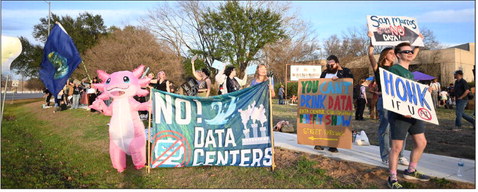
Daily Record photos by Shannon West