LOCAL HISTORY
Pennington Funeral Home leaves Comanche Street, city salvages materials before demolition
After nearly seven decades on Comanche Street, Pennington Funeral Home is leaving its longtime location as the building is set to be demolished for a future apartment complex.
Though the business will continue operating from a different location, the City of San Marcos worked to ensure the historic structure served the community right up until its demolition. Mate- rials from the building were shared with local nonprofits, while firefighters and police used the site for training exercises.
Bill Pennington, whose family has run the funeral home for three generations, shared some of its long history in the community. The business was started in 1897 by A.B. Rogers and Charles Edward Rugel as a furniture and coffin store. Pennington said in the early days, they used horse-drawn hearses and didn’t get the first motorized hearse until approximately 1915 or 1916.
In 1943, Rogers sold the business to longtime employees and Pennington’s parents Willard and Edra. Both of his parents were licensed funeral directors. His mother actually became the first female licensed funeral director in the state of Texas in 1935.
Pennington was raised in the apartment above the funeral home at the Comanche Street location. The business had two combination Cadillac hearses that could be used to transport bodies and as an emergency vehicle, making them an essential San Marcos business for both services.
Pennington drove his first ambulance at age 13 and went on his first call involving a death at age 14.
“You never get used to it,” he said.
In 1960, Pennington graduated high school early. He then became a licensed Funeral Director and Embalmer in 1962 and took over the business around 1969. Pennington passed the business to the third generation of his family around five years ago, but he still helps out.
“I’m still working,” Pennington said. “I can’t get it out of my blood.”
And the City of San Marcos is doing everything it can to ensure all of that history does not go to waste.
According to San Marcos City Council Member Matthew Mendoza, Mayor Jane Hughson had the idea to use the recyclable materials in the building, so they met with the developer, who was completely onboard with the plan.
Various organizations, including local home renovation nonprofits Mission Able and Operation Triage, removed reusable materials from the building such as windows, sinks, toilets, AC units, tiles, fans, wall outlets, granite countertops, mirrors, wood paneling, doors and fences. The goal is recycling and reuse instead of sending materials to landfills, and this could become the new norm for buildings set for demolition.
“Jane and I are putting in a proposal to either give discounts for the permits or give them free permits for demolition, as long as they let us come in here for as long as possible and let us do whatever we can,” Mendoza said. Diverting materials from the landfill is not a new practice for the city. Amy Thomaides, with the Community Enhancement department, said San Marcos has a Reuse Warehouse where residents can bring items that are still usable and can also shop for free on Saturdays from 8 a.m. to 12 p.m.
“We have worked with different apartment complexes to get their furniture when they completely renovated their offices,” Thomaides said. “We also work with Code Compliance’s Helping Hands Warehouse. When we get really nice items, we send them to Code first. That is for people in real need and available by appointment only.”
While much of the efforts at Pennington Funeral Home focused on salvaging reusable furniture and building materials, the team also uncovered several historically significant artifacts during the process.
Mendoza said that while digging through the building with Linda Coker, Chair of the Hays County Historical Commission, they discovered several items worth preserving. They found a pre-1959 48-star American flag, documents from around 1917, a newspaper from 1956 and historic materials related to the old city cemetery. These items were donated to the library’s historical archives.
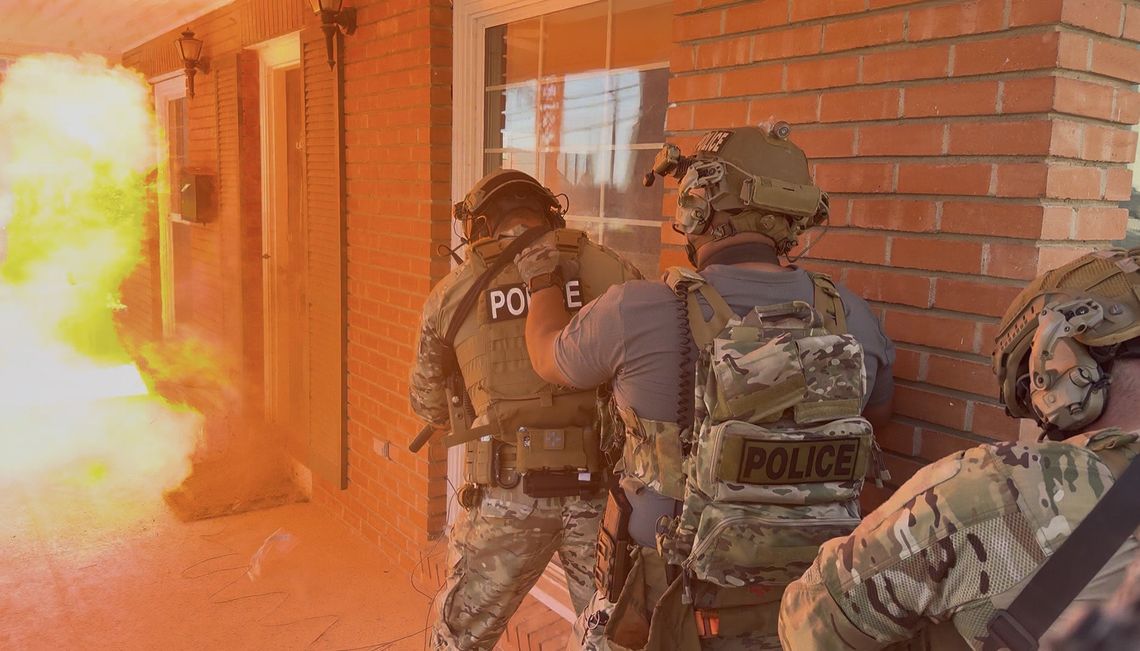
The building was also used to train San Marcos Police, Firefighters and Hays County SWAT team in the week leading up to its destruction.
“It allows them to perform roof access procedures,” Mendoza said. “It gives them the ability to knock down walls and learn how to break down windows; something we can’t do in real life.”
As for 323 North Comanche Street, that will be the location of a multi-family, seven-story apartment complex. Kelly Quinn is the Chief Executive Officer at Emerge Here, the woman-owned company that will be building “202 Hutch” where the Pennington Funeral Home once stood.
“We’re excited to be a part of the community,” Quinn said. “I feel like we worked really hard the last two years meeting with potential residents to really talk about what the needs are and what would be best for that site and for that building, as well as with the city and with the university. So I feel like we have a really good handle on the market, and we’re excited to have a development that shows that.”
Though Pennington Funeral Home will no longer operate from its longtime location on Comanche Street, its legacy will continue through its ongoing services, the resources it has shared with the community and the family whose roots remain deeply tied to San Marcos.

Pictured is the old Pennington Funeral Home building, which is visibly damaged from fire and police training operations. Daily Record photo by Shannon West

Pictured is the funeral parlor. Daily Record photo by Shannon West

Pictured is the embalming room. Daily Record photo by Shannon West

Pictured is the embalming recipe written on the wall of the embalming room. Daily Record photo by Shannon West

Hays County SWAT was able to train using the building. Daily Record photo by Shannon West

The roof of the building had holes from fire and police training. Daily Record photo by Shannon West

SMPD trains at the Funeral Home. Photos courtesy of Russell Wilde, with the city of San Marcos