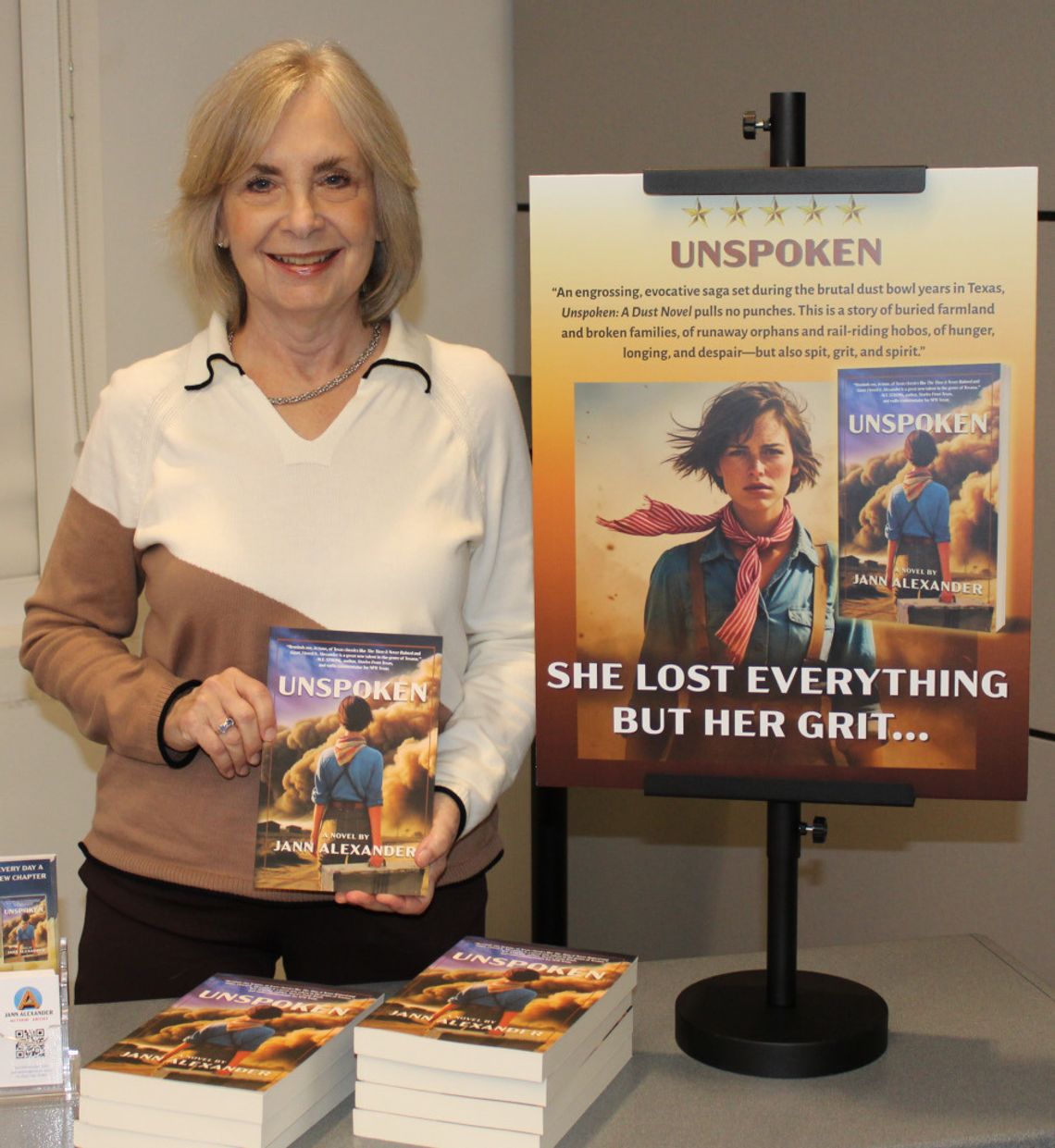
During the 1930s, the Dust Bowl in the Texas Panhandle brought widespread illness and severe hardship to those who experienced it. Author Jann Alexander used the Dust Bowl as the setting for her book “Unspoken,” which is about a fictional character dealing with the hardships of that time.
She spent about 10 years researching the Dust Bowl to make her fiction historically realistic, and she shared her knowledge with participants at the most recent Lifelong Learning San Marcos lecture series at the San Marcos library.
Alexander emphasized the devastating impact of dust storms, which could reach 600 feet high. People suffered from Dust Pneumonia, also called “The Brown Plague,” which was caused by inhaling fine soil.
“It was a blinding wall of dirt,” Alexander said. “It turned day into night, and any living thing caught in it would become disoriented and lost and even could suffocate, which happened to plenty of farm animals, sometimes people. And when you breathed it in, you coughed it out. And when you blew your nose, your handkerchief turned brown.”
She said the Dust Bowl occurred during the Great Depression, which had an additional negative impact on those living through it. The Great Depression started with the 1929 stock market crash. Texas farmers were hit hard because cotton prices collapsed, and they started producing more cotton, oversaturating the market and lowering prices further. Wheat prices also dropped drastically.
Alexander said many families were split up due to poverty and many children ended up in orphanages.
Alexander said the dust bowl was caused by both natural and human factors. The natural precursors were a severe drought paired with strong winds typical for the region. Humans overgrazed and destroyed native grasses, over-plowed fragile prairie soil using mechanized farming with combines, which allowed for large-scale wheat production but depleted soil.
Alexander said the federal government intervened to fix the crisis. The Soil Conservation Act passed in 1935 and created programs to prevent soil erosion. The Soil Conservation Service taught farmers new methods such as crop rotation and soil management. The Works Progress Administration was established and provided jobs building infrastructure such as bridges, schools and buildings, and the Civilian Conservation Corps worked on conservation projects and park development.
“Almost every state park we have here and Big Bend, also our national parks, were built thanks to the CCC,” Alexander said. “We really can thank them for trails, lodges and cabins, not just here in Texas, but all over the country.”
Alexander said by approximately 1940, rainfall returned, and new farming practices had helped stabilize the soil.
Alexander’s book, “Unspoken,” can be purchased on Amazon.