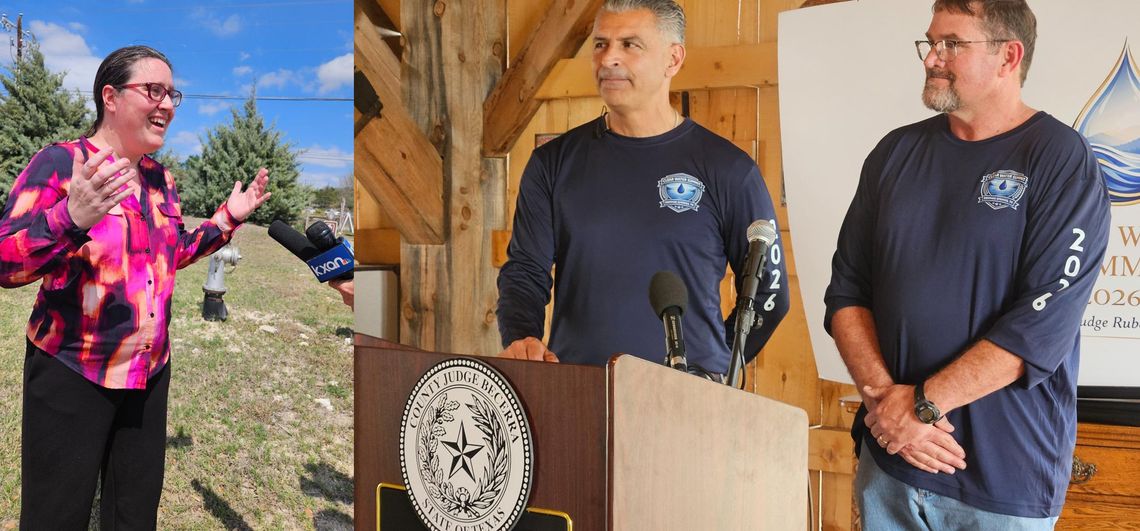
Tensions over how to address Hays County’s growing water challenges boiled over Friday after State Rep. Erin Zwiener was turned away from a water summit hosted by Hays County Judge Ruben Becerra, who said he did not want an “agitator” in the room.
Zwiener said after initially being excluded she had been invited to the summit, RSVP’d earlier in the week and was turned away at the door when she arrived. Becerra said her RSVP was sent to a staff member who was on vacation and did not make the attendee list.
The invitation-only “Clear Water Summit” was organized by Becerra and local water officials to bring together regional stakeholders to address growing concerns over water availability as development continues across Hays County.
The dispute comes as Hays County faces increasing pressure on limited groundwater supplies amid rapid growth and ongoing drought conditions.
Becerra defended the decision following the meeting saying she had “publicly undermined” efforts, and that the summit was intended to move past political disagreements and focus on coordination among water providers.
“I will not invite … someone [who is] a known agitator of this actual effort,” Becerra said. “That is not the energy I want in this summit at this time.”
He said the meeting was a “very fragile” first step and that his goal was to keep the discussion focused on collaboration among participants.
Zwiener pushed back on that characterization, saying she has worked on groundwater policy throughout her time in office and remains willing to collaborate.
“I’ve been working diligently on groundwater issues since day one of my election,” Zwiener said. “If he would like to be successful in working on them, my door is open.”
She also questioned Becerra’s involvement in the issue.
“I am glad that in year eight of his time in public service, Judge Becerra has discovered those issues,” she said.
Zwiener also suggested the effort may be politically motivated. The clash comes as Becerra and Zwiener, both Democrats, have been involved in ongoing disagreements over groundwater policy in the region. Becerra is currently in a Democratic primary runoff against Hays County Precinct 2 Commissioner Michelle Cohen.
“Quite frankly, I think this is more about attention than actual work,” Zwiener said.
Part of that tension stems from disagreements over legislation related to the Hays Trinity Groundwater Conservation District, which Zwiener worked to pass through the last legislative cycle.
“They have a broken funding structure, and so I worked very hard to try and pass legislation to fix that so that they can stay solvent,” Zwiener said. “We did pass that bill through the Texas House, over the objection of folks like Dripping Springs water supply and Representative Carrie Isaac. The bill passed the Senate unanimously, and then there was a very successful campaign to get that bill vetoed. So right now, we are at risk of our groundwater district becoming insolvent and having no protection over our groundwater.”
Mark Key, a Dripping Springs Water Supply Corporation board member who Becerra tapped to help organize the summit, was part of a group that helped secure Gov. Greg Abbott’s veto of the bill.
DSWSC, the water supplier for much of northwest Hays County including the city of Dripping Springs, opposed the measure.
Key said he was proud to have fought the legislation.
“I fought it tooth and nail, because that legislation would have stripped away all exempt well rights for people with less than 10 acres,” Key said previously. “...Their wells would have suddenly been subject to fees, fines and legislation by the Hays Trinity Groundwater Conservation District, so you’re damn right I fought it.”
Zwiener said she did not recall telling local officials the legislation “was going to pass whether you like it or not,” as Key claimed during the press conference.
Becerra pointed to that dynamic in explaining why he did not want Zwiener at the summit, saying he was trying to avoid confrontational rhetoric and keep the discussion focused on collaboration.
Zwiener emphasized that she planned to attend the meeting and said she has worked on groundwater issues alongside local stakeholders for years, seeking to ensure those voices were represented in the discussion. She said she wanted to advocate for local groundwater districts, including the Hays Trinity Groundwater Conservation District, which she feared could come under attack during the summit.
“I was concerned this was going to be a vehicle for them to attack the groundwater district, and wanted to make sure that if that happened, I could be there to speak up for them,” Zwiener said.
“The groundwater district has been very nervous to participate in any of this, because they are currently in litigation with DSWSC,” she said. “Those legal fees are threatening the financial solvency of the district.”
The Hays Trinity Groundwater Conservation District did not immediately respond to a request for comment after business hours Friday.
Becerra and Key said the summit was intended to bring together water providers, policymakers and regional stakeholders to begin coordinating responses to growing supply concerns. Zwiener called together her own working group of elected officials, nonprofit leaders and long-time water advocacy organizations to examine how high-water-use developments — particularly data centers — are affecting communities in Hays County.
Becerra said that nearly 100 participants representing water utilities, groundwater districts, regional authorities and neighboring counties attended the water summit on Friday. He said discussions focused on water availability, infrastructure challenges and long-term planning as the region continues to grow.
Officials said early conversations included improving regional coordination, sharing data on groundwater levels, addressing aging infrastructure and exploring expanded water reuse.
They also said demand from large industrial users, including but not limited to data centers, is becoming an increasingly frequent concern in local water planning discussions.
Becerra said he plans to hold similar summits on a quarterly basis, with future meetings aimed at refining ideas and developing recommendations for lawmakers and local officials. He and Key said they remain open to future conversations with the state representative. Zwiener said she would participate in future discussions if allowed and emphasized that she is ready to use her role in the legislature to help build solutions around groundwater management and local control.